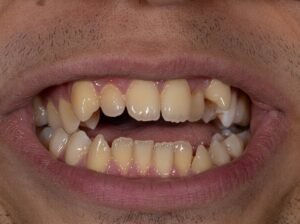
A few weeks ago, a 28-year-old young man walked in. He brought a box with broken retainers and the face of someone who just can't take it anymore. He had spent three years in braces that he got at a clinic advertising orthodontics starting at $6,000 pesos. When I took a new X-ray and compared it to the one he brought from the start, my heart sank. He had shortened roots on his front teeth, inflamed gums, and a bite that was colliding all over the place.
The worst part wasn't telling him what I saw. The worst part was explaining that those "cheap" braces he got to save money would now cost him more than triple to fix the disaster. And that some things, like the root shortening, were irreversible.
That's why I want to talk to you about this today. Because I see it every week. Because it angers me that you're sold smoke. And because orthodontics is not a bargain product: it's a medical treatment that moves teeth inside your bone. And that, if done poorly, comes at a very high cost. Not in pesos. In health.
Cheap orthodontics almost always ends up being expensive
There's a phrase I repeat often in my practice: "Cheap almost always ends up being expensive." And I don't say it just to say it. I say it because I've had to fix too many cases that started with "but the price was so good." A doctor who truly knows what they're doing, who has studied for years, who keeps up to date, and who works with quality materials cannot charge pennies. It's not arrogance. It's that knowledge costs. Experience costs. And your health shouldn't be where you scrape for savings.
When you see an ad for braces at half price, the first thing you need to ask yourself is: what are they cutting out to lower the cost so much? Are they cutting out the specialist? Are they cutting out the diagnostic tests? Are they cutting out the good materials? Because the bracket itself is a tiny piece of metal worth pennies. What you're paying for is the complete treatment, the doctor's time, their knowledge, and the follow-up.
What a budget too low includes and what it hides
When someone offers you orthodontics for $6,000 pesos, chances are they're not including many things that are fundamental. And the serious part is that sometimes they don't even mention them to you. They don't tell you that monthly adjustments are charged separately. They don't tell you that the final retainers aren't included. They don't tell you that if a bracket comes off, the replacement has an extra cost.
At a specialized clinic, when we give you a price, we give you the price for the complete treatment. With everything. Including diagnostic studies, X-rays, monthly adjustments, emergencies, and the final retainers. So you know from day one what you'll pay and don't get surprises halfway through. If you want to know how we work, I invite you to read why our patients trust AM Dental Studio.
And there's something even more important than money. Something you don't see in your wallet but you do see on X-rays five years later.
The damage you don't see until it's too late
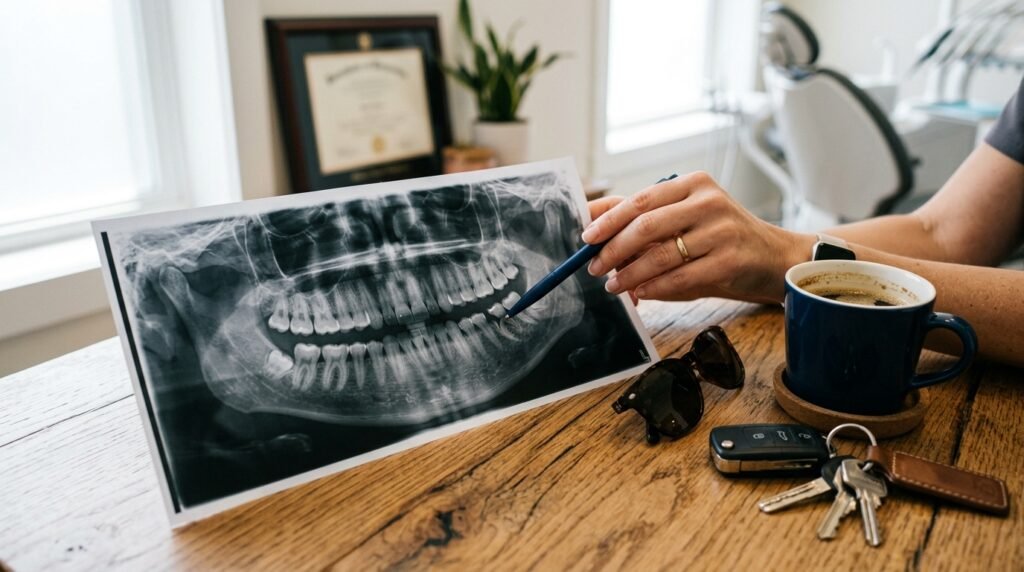
The problem with poorly done orthodontics is that the damage doesn't appear the next day. It appears after a year, two years, five years. And when it appears, often there's no way to fully repair it.
When the root of the tooth shrinks forever
This is called root resorption. In plain English: the root of the tooth gradually shortens because the forces applied to move it were too strong or poorly directed. Imagine you have a screw in the wall and you pull on it with too much force. The screw holds, but the wall around it starts crumbling. Here, the wall is your bone and the screw is your tooth's root.
When a specialist plans your orthodontics, they know exactly how much force to apply, in which direction, and for how long. They know how to read X-rays to see how your roots are before starting and how they're responding during treatment. A dentist who isn't a specialist, or who learned orthodontics in a weekend course, often just places brackets and tightens wires hoping the teeth will move. And they do move. But sometimes they move badly. And the roots get damaged.
The worst part is that root resorption doesn't hurt. It doesn't warn you. One day you get a control X-ray and discover that several teeth have roots so short that they probably won't survive in the long term. And that has no fix.
Bite problems that didn't exist before
Another disaster I see frequently is the patient who started their orthodontics with a normal bite and ended with a bite that collides, hurts when chewing, or causes jaw clicking. Moving teeth isn't just about making them straight. It's about making sure they fit together well, that the contacts are correct, and that the jaw ends up in a healthy position.
Poorly planned orthodontics can leave you with a traumatic bite, jaw joint pain, headaches, and even accelerated tooth wear. All for an initial "savings." If you're feeling any unusual discomfort during your treatment, please don't ignore it. Sometimes dental sensitivity that appears out of nowhere is the first sign that something isn't right.
The difference between a real orthodontist and someone who just places brackets
I'm going to be very clear about this, because I think it's the most important thing I'm going to tell you in this entire article. An orthodontist is not the same as a general dentist who does orthodontics.
How to know if you're in good hands?
An orthodontist is a dentist who, after dental school, studied a specialty for two to four additional years. Just in orthodontics. They have seen hundreds of cases supervised by expert professors, have studied how the face grows, how teeth move within the bone, and how to diagnose each case individually. They have a specialty license that certifies them.
A general dentist may have taken a diploma course of a few months, or even just a short course. They may have good intentions, but they lack the full training to diagnose risks or plan a safe long-term treatment.
When you come to see me at the clinic, the first thing I do is a complete diagnostic workup: panoramic X-ray, lateral cephalometric X-ray, photos of your face and teeth, and digital models. With all that, we design a personalized treatment plan. Because your mouth is not the same as anyone else's. And because you can't do a good job without knowing exactly where we're starting from. That's how we work with our traditional braces orthodontics and also with Invisalign for those seeking a more aesthetic option. And if during the study I see something I don't like, such as inflamed gums or accumulated tartar, the first thing I recommend is a professional dental cleaning before starting any movement. Because you don't build a house on dirty foundations.
The questions that save your mouth
If you're thinking about getting braces and want to make sure you're in good hands, ask these five questions. If they answer you clearly and without beating around the bush, it's a good sign. If they get annoyed or give you evasions, get out of there.
1. Can you show me your specialty license? A real orthodontist has one and has no problem showing it to you. 2. Are you going to take X-rays and do a complete diagnostic workup before starting? Without diagnosis, there's no safe treatment. Period. 3. Are you going to give me a written treatment plan with estimated timelines? You need to know what to expect from the beginning. 4. Does the price include adjustments, emergencies, and final retainers? Don't let them slip in hidden charges. 5. What happens if something goes wrong during treatment? A good professional will explain the emergency protocol without any issue.
Frequently Asked Questions
1. Why are some braces so cheap?
Because the diagnostic X-rays, monthly adjustments, retainers, and specialist care are often left out of the quote. The real final price inflates with hidden charges.
2. Can a general dentist place braces?
In Mexico, it's not prohibited, but orthodontics is a specialty that requires years of additional training. Delegating it to someone without that training multiplies the risk of irreversible damage.
3. What is root resorption?
It's the irreversible shortening of the tooth root caused by excessive or poorly directed forces. It doesn't hurt and can only be detected with X-rays. It's one of the most serious risks of cheap orthodontics.
4. How do I know if my orthodontist is good?
Ask to see their specialty license, demand a complete diagnostic workup with X-rays before starting, and be suspicious of anyone who promises ultra-fast results without prior studies.