
It's 11 PM. You walk past your child's room and you hear it: that teeth grinding that makes your skin crawl. Next to their pillow, the tablet is still warm. The conclusion seems obvious: "it's because of the tablet." And yes, the tablet has something to do with it. But if you only take away the screen and don't check everything else, it's very likely the grinding will continue.
Childhood bruxism, that is, clenching or grinding the teeth, is much more common than you imagine: according to studies, it affects between 3.5% and 40% of children aged 2 to 12, depending on how it's measured. Many parents discover it because of the noise; others, because the child wakes up with a headache or jaw pain, or because their dentist notices worn teeth.
That's the key to this article: the tablet isn't the only culprit, it's the accelerator. What needs to be understood is what's happening with your child's stress, sleep, and breathing. Let's take it step by step.
In this article
- Why does my child grind their teeth while sleeping?
- Does the tablet cause bruxism? What the science says
- The childhood stress parents don't see
- Snoring, mouth breathing, and bruxism: the forgotten connection
- ¿Cuándo preocuparme?
- What to do at home and what we do in the office
- Frequently Asked Questions
Why does my child grind their teeth while sleeping?
Because childhood bruxism has several causes that add up: stress or anxiety, poor sleep quality, breathing problems during sleep, and habits like screens at night. It's rarely a single factor.
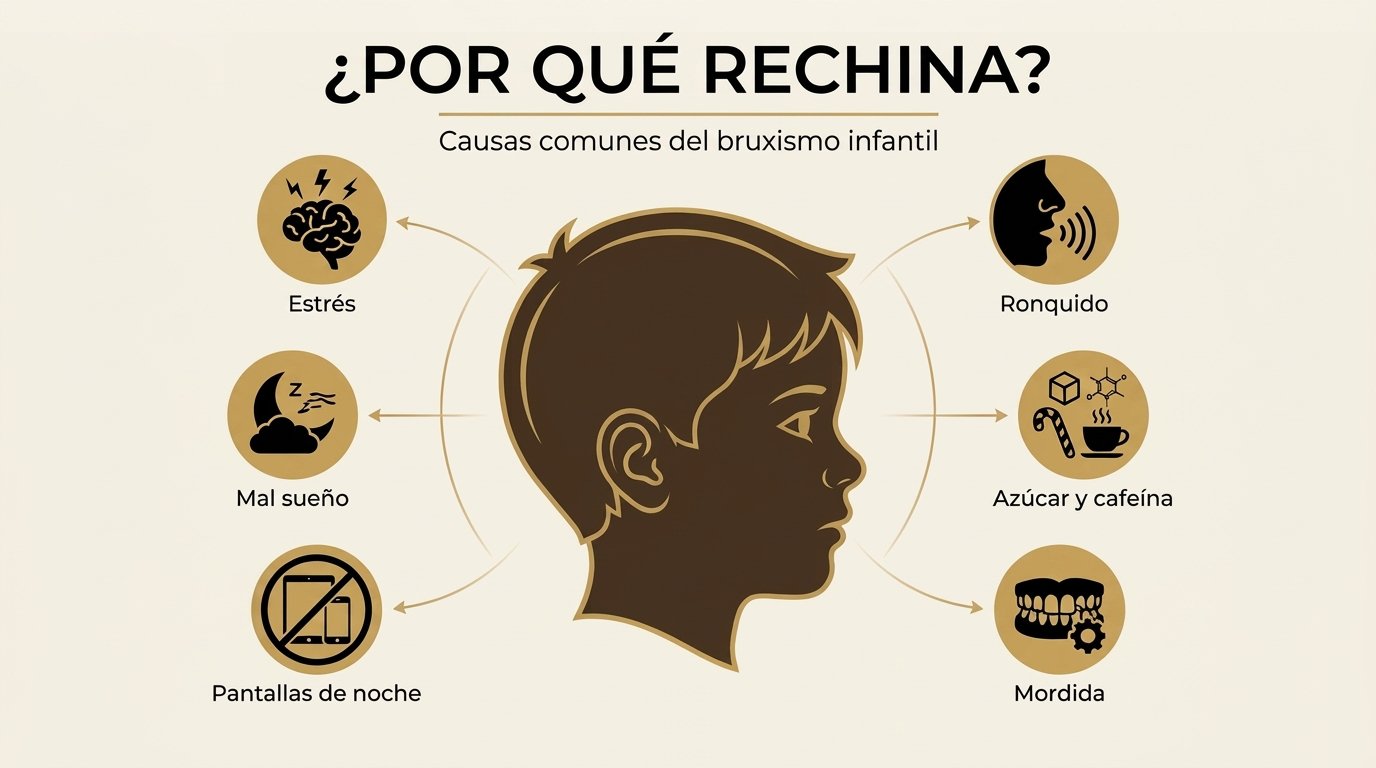
For years it was thought that children ground "because their teeth didn't fit together well." Today we know that the bite plays a minor role. Scientific reviews describe childhood bruxism as a problem of multifactorial origin, where factors of the nervous system and sleep weigh much more than the shape of the teeth.
We need to distinguish two types:
- Sleep bruxism: the one you hear at night. It happens during micro-arousals, those small "startles" of the brain that the child doesn't even remember. The more fragmented the sleep, the more opportunities there are to grind.
- Awake bruxism: clenching the teeth during the day, for example while playing video games, doing homework, or watching something that tenses them up. Almost no one notices this one.
Did you notice that the same thing appears in both types? A nervous system on alert. That's why, in the office, when a mom tells me "my child grinds," my first questions aren't about their teeth. They're about their sleep, their schedules, school, home, and whether they snore.
| Factor | Cómo influye | Peso |
|---|---|---|
| Estrés y ansiedad | Tensión que el cuerpo descarga en la mandíbula | High |
| Sueño de mala calidad | Más microdespertares = más episodios de rechinido | High |
| Pantallas de noche | Retrasan el sueño y mantienen el cerebro activado | Medio, acelerador |
| Ronquido / respiración por la boca | Un sueño interrumpido por falta de aire se asocia a más bruxismo | Medio, subestimado |
| Azúcar y cafeína en la noche | Refrescos de cola, chocolate o té frío activan al niño | Medium |
| Mordida o dientes | Puede influir, pero rara vez es la causa principal | Bajo |
If stress and sleep are the center, where does the tablet fit in? Right in the middle of both. And that's what the most recent studies are beginning to show.
Does the tablet cause bruxism? What the science says
The tablet hasn't been shown to cause it directly, but it does make it worse. Several studies associate more screen time with more bruxism, and reducing it has decreased grinding in children.
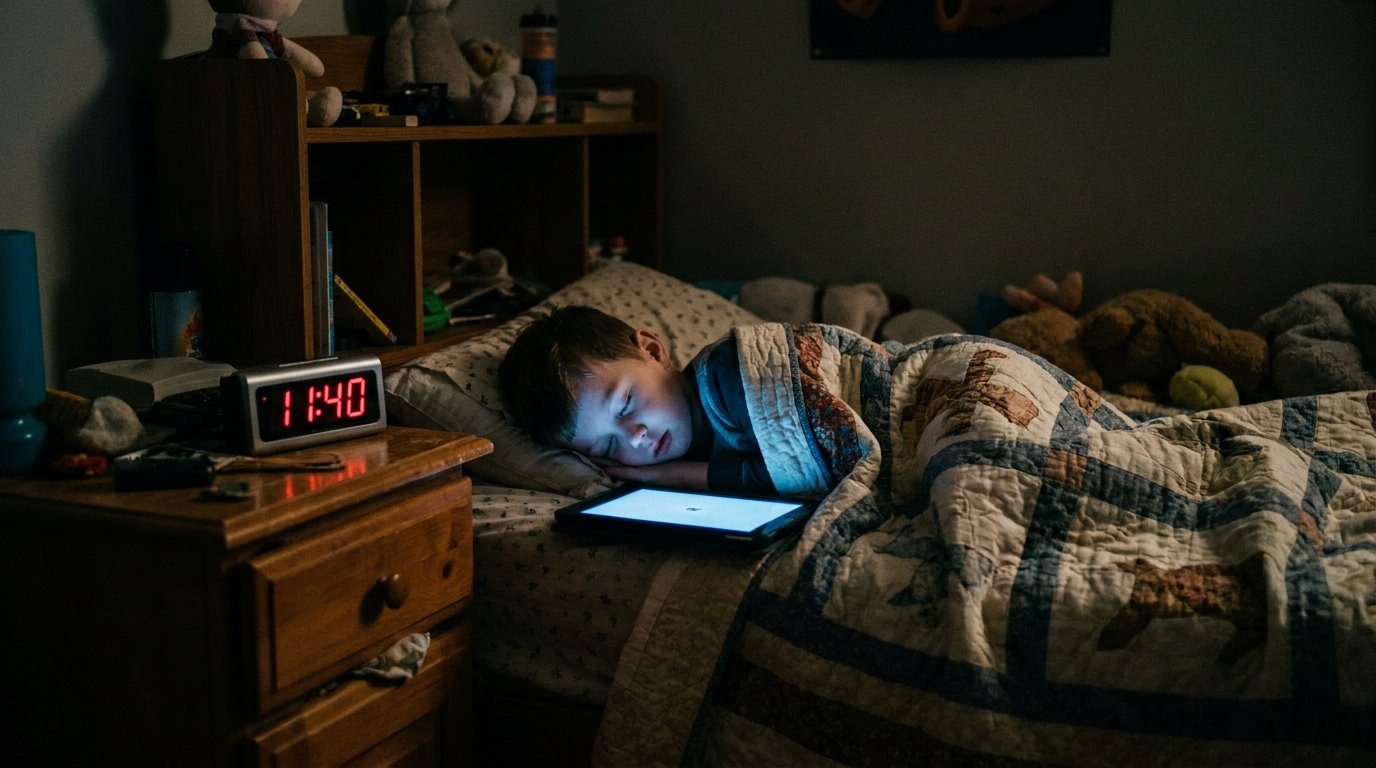
I'm going to give you the complete data, not just the part that scares. In 2026, a systematic review was published in Brazilian Oral Research that analyzed 13 studies on screens and bruxism in children and adolescents. Eight of the thirteen found an association: more hours in front of the screen, more bruxism, especially when there was problematic use of the device. But the quality of the evidence was low and the authors conclude that it still can't be affirmed that the screen, by itself, causes bruxism.
Now, the other side. A clinical trial conducted in children aged 4 to 8 in Colombia and Argentina (2024) worked with families to reduce screen time and sugar consumption. Result: the frequency of bruxism dropped significantly in the first six weeks. It's a small study, but it points to what we see in the office: when the night is put in order, the grinding usually decreases.
How the tablet "turns on" your child at night
- Stimulation: fast videos, games with rewards, and sounds keep the brain in alert mode. It's exactly the opposite of what it needs to sleep.
- Screen light: exposure to bright light at night delays the body's natural sleep signal.
- Fewer hours of sleep: "one more video" turns into 40 minutes less rest.
- Emotion without release: losing a game or watching something that scares them leaves the child tense right before closing their eyes.
Here's how I explain it to parents: tablets late at night keep the child in a constant state of alert, don't let them rest, and can give them insomnia. That accumulated fatigue is another form of stress, and the body releases it however it can: through the jaw.
So yes: taking the screen away at night helps. But if your child arrives at bed carrying tension from the whole day, the tablet is only the last drop. Where does that tension come from?
The childhood stress parents don't see
Children get stressed by changes, school pressure, conflicts at home, or too many activities, and they almost never say it in words. Grinding can be one of the ways their body expresses it.
When I say "stress" in the office, many parents answer me: "but he's a child, what would he be stressed about?" About many things. Children experience stress just like us, but they don't have the tools to name it. That's why they somatize it: they turn it into stomachaches, tantrums, trouble sleeping, or clenching their teeth.
Common triggers
- Big changes: moving, a new sibling, changing schools, parents separating.
- School pressure: exams, homework until late, conflicts with classmates.
- Overloaded schedule: school, extracurricular classes, traffic, homework, and zero real free time. In a city like Guadalajara, where many families spend hours in the car, a child's day can be as heavy as an adult's.
- Tension at home: children absorb the atmosphere even if it isn't discussed in front of them.
- Content that unsettles: scary videos, competitive games, or news they hear in the background.
Signs that your child is tense
In addition to the grinding, notice if irritability, more frequent tantrums, trouble falling asleep, nightmares, nail biting, headaches, or stomachaches without a clear cause appear. If you see several together, the grinding is probably the tip of the iceberg.
Here I want to be clear: I'm a dentist and I don't diagnose anxiety. What I do is help you connect the dots. If the bruxism comes with significant behavioral changes, the ideal is for your pediatrician or a child psychologist to evaluate it as well. Treating only the teeth would be treating the symptom and leaving the cause untouched.
There's one more factor that almost no article mentions, and that completely changes the approach: does your child snore or sleep with their mouth open?
Snoring, mouth breathing, and bruxism: the forgotten connection
Children with sleep-related breathing disorders, such as snoring or pauses in breathing, present bruxism more frequently. If your child grinds and also snores, their airway needs to be checked.
This is the part I most want you to take away. A study in Spanish children found that those with possible sleep bruxism had a significant association with sleep-related breathing disorders: snoring, difficulty breathing, and a feeling of suffocation while sleeping. Other studies have observed that anxiety and altered breathing increase as the grinding becomes more frequent.
Why would this happen? When the airway partially closes during sleep, the brain triggers micro-arousals to "rescue" breathing. And as we saw, those micro-arousals are exactly when the grinding appears. The child doesn't know it, you only hear the noise, but behind it there may be a breathing problem.
Check these signs tonight
- Snores three or more nights a week (without being congested).
- Sleeps with the mouth open or with the head tilted far back.
- Moves a lot, sweats, or pauses while breathing.
- Wakes up tired, with a dry mouth, or in a bad mood.
- Wets the bed after having stopped using diapers.
If you checked two or more, don't stop at the bruxism alone. I recommend reading our guide on why snoring in children isn't normal, because there we explain what tests are done and which specialist to start with. Many times, when the obstruction is resolved, the grinding improves on its own.
In the dental check-up, clues also appear that parents don't see: a narrow, deep palate, red and inflamed gums on the front teeth, dry lips, and crowded teeth from a very young age. When we find that pattern in a child who also grinds, the mouth is telling us the same story as the snoring: air isn't passing well through the nose.
You already have the pieces: stress, sleep, screens, and breathing. The next question is the one that worries parents the most: is this serious or will it go away?
When should I worry about my child's bruxism?
El rechinido ocasional y sin síntomas suele ser pasajero. Consulta si es casi diario, si hay dolor, desgaste visible, ronquido o cambios en su conducta y concentración.
I have good news for you: in many children, bruxism tends to decrease with age, as the teeth change and the nervous system matures. Scientific reviews insist that not all childhood bruxism needs treatment; it's treated when there are complications. The problem is that "waiting for it to go away" without checking anything can let exactly those complications slip by.
| Situation | What to do |
|---|---|
| Rechina de vez en cuando, duerme bien y amanece de buen humor | Observar y mejorar hábitos de sueño |
| Rechina casi todas las noches | Revisión dental para valorar desgaste |
| Se queja de dolor de mandíbula, oído o cabeza al despertar | Revisión dental pronto |
| Dientes de leche muy planos, astillados o sensibles | Revisión dental |
| Ya tiene dientes permanentes y siguen desgastándose | Consulta prioritaria |
| Además ronca, hace pausas al respirar o duerme con la boca abierta | Consulta dental y con otorrino |
| Cambios fuertes de conducta, ansiedad o insomnio | Consulta con pediatra o psicólogo, además del dentista |
And what consequences can it have if it's not addressed? In baby teeth, the wear is usually more cosmetic than serious, but it can lead to sensitivity. When the habit continues into the permanent dentition, the wear no longer recovers. Outside the mouth, what worries us most is what the grinding reveals: a child who isn't resting, with everything that implies for their mood, their attention in class, and their growth.
By the way, a clarification I make often: the popular belief that grinding teeth is a sign of "worms" doesn't have a solid scientific basis. If you suspect parasites, have the pediatrician evaluate it, but don't take it for granted that's the cause and stop checking sleep and stress.
What to do at home and what we do in the office
At home: turn off screens at least an hour before bed, remove devices from the bedroom, a calm routine, and fixed schedules. In the office: we check wear, bite, and airway; mouthguards aren't the first option in young children.
The good thing about childhood bruxism is that a large part of the solution is in your hands and doesn't cost money. I suggest trying this for two weeks and observing whether the grinding changes:
- Digital curfew: no tablet, phone, or TV for at least 60 minutes before bed. It's the recommendation of the American Academy of Pediatrics.
- Devices sleep outside the bedroom. They charge in the kitchen or the living room, not next to the pillow.
- Fixed schedule for sleeping and waking, also on weekends (with a one-hour tolerance).
- Light dinner and no caffeine: no cola sodas, iced tea, or chocolate at night.
- Calming ritual: warm bath, story, talking about the day. Ten minutes of connection.
- Listen and take notes: how many nights they grind, if they snore, if they breathe through their mouth. That log is extremely useful for us in the office.
| Edad | Recomendación | Fuente |
|---|---|---|
| Menores de 2 años | Evitar pantallas (salvo videollamadas con la familia) | OMS / AAP |
| 2 a 4 años | Máximo 1 hora al día, contenido de calidad y acompañado | OMS |
| 5 años en adelante | Límites claros que no le quiten sueño, juego ni actividad física | AAP |
| Todas las edades | Pantallas apagadas 1 hora antes de dormir y fuera del cuarto | AAP |
What we do at AM Dental Studio
In the evaluation we check the degree of wear on the teeth, the bite, the jaw joint, and signs of mouth breathing (narrow palate, dry lips, inflamed gums at the front). With that we decide whether it's enough to observe and adjust habits, whether some tooth needs protection, or whether it's best to refer them to the ENT.
About night guards: in young children they aren't the first option, because their jaws are still growing and a poorly indicated guard can interfere with that growth. They're considered in specific cases and with close follow-up. If you want to understand how bruxism affects the long term, you may also be interested in our article on why baby teeth matter so much.
Does your child grind almost every night or also snore? Schedule an evaluation. Checking in time costs much less than correcting later, and you'll leave with a clear plan, not a default mouthguard.
Frequently Asked Questions
¿Es normal que mi hijo rechine los dientes dormido?
Es frecuente, pero no siempre normal. Si ocurre casi todas las noches, hay dolor, desgaste o ronquido, conviene una valoración dental.
¿La tablet causa bruxismo en los niños?
No se ha demostrado que lo cause sola, pero más horas de pantalla se asocian a más bruxismo, y reducirlas lo ha disminuido.
¿El bruxismo infantil se quita solo?
En muchos niños disminuye con la edad. Aun así, conviene revisar estrés, sueño y respiración, y vigilar el desgaste en los dientes permanentes.
¿Mi hijo necesita una guarda para el bruxismo?
Generalmente no en niños pequeños, porque sus maxilares están creciendo. Se indica solo en casos específicos y con seguimiento del dentista.
¿Rechinar los dientes es señal de lombrices?
No hay evidencia sólida de eso. Si sospechas parásitos, que lo valore el pediatra, pero revisa también el estrés, el sueño y si ronca.

Sources consulted
- Is bruxism associated with the use of screen devices in children and adolescents? A systematic review — Brazilian Oral Research (2026)
- Effect of screen-time and sugar consumption reduction on sleep bruxism in children: randomized clinical trial — Universidad CES (2024)
- Intervenciones para reducir el bruxismo en la infancia (European Journal of Pediatrics, 2020) — IntraMed
- Trastornos del sueño infantil y bruxismo del sueño — Científica Dental (COEM)
- AAP: recomendaciones de pantallas antes de dormir — AASM
This article is for informational purposes and does not replace a personalized clinical evaluation.