
You're in the supermarket aisle. One box promises "luminous white in 7 days," another boasts activated charcoal, and another, "professional formula." None of them tells you what I am going to tell you: most of those toothpastes don't change the color of your tooth. What they do is polish it. And if you combine them with a hard brush and a lot of force, that polish turns into wear.
In February 2026, Profeco analyzed 46 toothpastes sold in Mexico, 16 of them whitening. All met fluoride and pH standards. Good news, right? Yes, but be careful: meeting fluoride and pH standards means the toothpaste is safe for cleaning, not that it will whiten your teeth. Those are two very different things, and the packaging plays precisely on that confusion.
This isn't a campaign against your favorite toothpaste. It's what we see every week in the office here in Guadalajara: patients who have been "whitening" at home for years and arrive with sensitivity, teeth more yellow than before, and a marked tooth neck. Let me explain why this happens and what actually works.
In this article
- Do whitening toothpastes really whiten?
- Who wears you down: the toothpaste or the toothbrush?
- RDA: the number your toothpaste doesn't tell you
- Signs that your enamel is already wearing down
- What actually whitens (and when you don't need it)
- How to use your toothpaste without damaging your teeth
- Frequently Asked Questions
Do whitening toothpastes really whiten?
Not in the way you think. A whitening toothpaste removes surface stains (coffee, tea, wine, tobacco), but it doesn't change the internal color of the tooth. That color can only be changed with a peroxide whitening treatment supervised by your dentist.
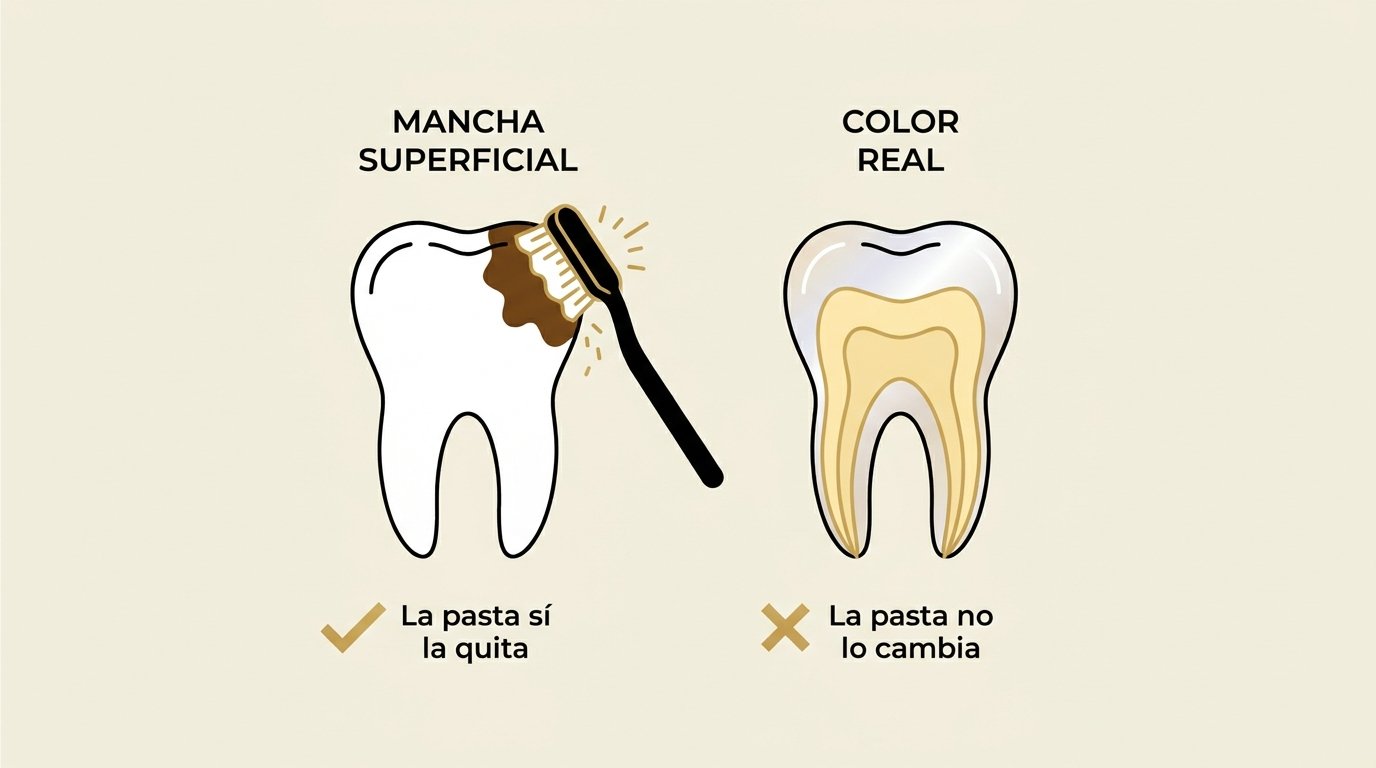
To understand this, we need to distinguish two types of stains. The extrinsic stain is the one that sticks to the outside: morning coffee, tea, red wine, cigarettes. The intrinsic stain is the tooth's own color, which depends mainly on the dentin, the yellowish layer beneath the enamel. Your toothpaste can help with the first. With the second, practically not at all.
Why, then, do you feel your teeth "look whiter" the first week? Because the toothpaste removed the layer of surface pigment. That's cleaning, not whitening. And there are toothpastes that go one step further with an optical trick: blue covarine, a blue pigment that deposits on the tooth and makes it look less yellow for a few hours. It washes off with the next meal.
| Mecanismo | Qué hace en tu diente | ¿Cambia el color real? | Riesgo con uso diario |
|---|---|---|---|
| Abrasivos (sílice, carbonato de calcio, perlita) | Pulen y raspan la mancha superficial | No | Desgaste de esmalte y dentina si son muy abrasivos |
| Agentes químicos (pirofosfatos, hexametafosfato) | Despegan el pigmento y evitan que se vuelva a fijar | No | Bajo |
| Peróxido en dosis muy baja | Contacto de segundos con el diente; efecto mínimo | Casi nulo | Bajo, pero tampoco resuelve |
| Blue covarine (pigmento azul) | Ilusión óptica temporal | No | Bajo; efecto de horas |
| Carbón activado | Abrasión intensa de la superficie | No | High: de las más abrasivas |
The point about peroxide deserves its own paragraph, because it's marketing's favorite hook. In a professional whitening treatment, we use hydrogen peroxide concentrations of around 25 to 40% in the office, or carbamide peroxide of 10 to 22% in trays for home use, always with the tooth isolated and the gum protected. In an over-the-counter toothpaste, the amount is minimal (in the European Union, for example, the cap for over-the-counter products is 0.1%) and it's in contact with your tooth for barely two minutes, diluted in saliva.
That's why I'm so blunt about this topic: a product strong enough to truly whiten couldn't be gentle enough for you to use on your own, every day, without protecting your gum. If it were safe and effective at the same time, professional whitening wouldn't exist.
A 2023 review published in Annals of Anatomy confirmed it with the trendy product: most activated charcoal toothpastes produced insignificant color changes, and the little effect they achieved was from abrasion, not whitening. Now comes the uncomfortable question: if the toothpaste doesn't whiten, what's happening to your enamel every time you brush?
What wears down your enamel: the toothpaste or the toothbrush?
Mainly the toothbrush and the way you use it. The toothpaste adds wear when it contains strong abrasives, which is exactly what many whitening toothpastes have. The combination of a hard brush + force + abrasive toothpaste is what does the most damage.
Here I want to be very honest, because it's something almost no article explains well. Toothpaste, by itself, doesn't "eat away" the tooth. I repeat it a lot in the office: the wear comes from the toothbrush, not from the toothpaste itself, unless the toothpaste has abrasive agents. The problem is that whitening toothpastes depend precisely on those abrasives to remove stains.
Imagine a piece of sandpaper. Sandpaper alone on the table does nothing. But if you rub it with force, every day, two or three times a day, for years, the result shows. In your mouth, the toothbrush is the hand and the abrasive toothpaste is the sandpaper.
The wear formula we see in the office
- Hard or medium bristle brush "because it cleans better" (it doesn't).
- Too much force: if your toothbrush bristles splay before three months, you're pressing too hard.
- Horizontal movement side to side, like a saw, especially on canines and premolars.
- Very abrasive toothpaste every day, not just occasionally.
- Brushing right after something acidic (orange juice, soda, coffee with lemon, wine), when the enamel is temporarily softened.
When you combine three or four of those factors, the wear stops being theoretical. And enamel has one detail that changes everything: it doesn't regenerate. What's lost is lost forever. Fluoride can strengthen what remains, but it doesn't "refill" what's already gone.
The yellow irony: the more you "whiten," the more yellow you look
This is the fact that surprises my patients the most. Enamel is semi-transparent and the dentin underneath is yellow. When you thin the enamel by polishing it away, the dentin shows through more and the tooth looks more yellow. In other words, the person who uses aggressive whitening toothpaste for years can end up with darker teeth than when they started.
And then what do they do? They buy a "stronger" toothpaste. The cycle repeats. At AM Dental Studio we see this pattern frequently in young adults who never imagined that their hygiene routine was the cause of the problem. How do you know if your toothpaste is one of the ones that sand? There's a number for that, but it almost never comes on the box.
RDA: the number your toothpaste doesn't tell you
The RDA (Relative Dentin Abrasivity) measures how abrasive a toothpaste is. The international standard ISO 11609 sets a maximum of 250. The lower it is, the gentler it is on your teeth.
RDA is a laboratory index that compares how much a toothpaste wears down dentin against a reference abrasive. The International Organization for Standardization (ISO) establishes that a toothpaste must not exceed an RDA of 250 to be considered safe for a lifetime. The problem: within that "allowed" range there are very gentle toothpastes and others that are close to the limit.
| Rango RDA | Nivel | Para quién |
|---|---|---|
| 0 – 70 | Baja | Sensibilidad, encías retraídas, raíz expuesta, niños |
| 70 – 100 | Media | Uso diario en boca sana |
| 100 – 150 | Alta | Uso ocasional; no con cepillo duro |
| 150 – 250 | Very high | No recomendable a diario; aquí caen muchas blanqueadoras y de carbón |
This scale is a widely used reference classification in dentistry; the only official limit is the maximum of 250 set by the ISO standard.
In Mexico, almost no brand prints the RDA on the packaging. You can look it up on the manufacturer's website or ask us at your next appointment. In the meantime, there are clues that help you suspect: the words "extra white," "charcoal," "intense polish," or "stain remover" usually go hand in hand with more abrasives.
A study published in Clinical Oral Investigations (2023) evaluated several whitening toothpastes over three months and found that all of them reduced the surface hardness of the tooth, and that those with blue covarine and activated charcoal did so significantly. The authors conclude something I fully agree with: these toothpastes should be used with caution.
If you've been using these types of toothpastes for a while, the logical question is: have I already damaged myself? Your mouth gives you fairly clear signals.
Signs that your enamel is already wearing down
Sensibilidad al frío, dientes que se ven más amarillos o translúcidos en las orillas, y pequeñas muescas cerca de la encía son las señales más comunes. Si tienes dos o más, vale la pena una revisión.
Wear from brushing doesn't hurt overnight. It progresses silently for years, and that's why many people come in when restoration is already needed. Review this list honestly:
- It hurts or "stings" with cold water, ice cream, or air when you breathe through your mouth.
- Your teeth look more yellow than a few years ago, even though you "take better care of them."
- The edges of your front teeth look grayish or transparent.
- You have a notch or step at the neck of the tooth, right where the gum begins (it's called abfraction or cervical abrasion, depending on the cause).
- Your gum looks "lower" and the root shows, which is more yellow.
- Your toothbrush splays in less than three months.
There's an important nuance: not all notches near the gum are from brushing. Bruxism (clenching or grinding your teeth) also generates wear and lesions at the neck of the tooth, and often the two causes add up. That's why I don't like anyone self-diagnosing: in the office we review the wear pattern, your bite, and your brushing technique before deciding what to do.
Can it be reversed?
Lost enamel doesn't come back. What we can do is stop the progression (change technique, brush, and toothpaste), control sensitivity with products and in-office fluoride, and, when the lesion is deep, protect the area with resin. The sooner we detect it, the less we'll have to intervene.
The good news is that, if what you're looking for is a brighter smile, there are options that work. The bad news: they don't come in a 75 ml tube.
What actually whitens (and when you don't need it)
The good news is that, if what you're looking for is a brighter smile, there are options that work. The bad news: they don't come in a 75 ml tube.
I'm going to tell you something you don't expect from a clinic: not everyone needs whitening. Many patients come in asking to whiten and, after a professional cleaning with polishing, realize they already like their natural color. If the problem was coffee or tea pigment, the prophylaxis resolves it without touching the tooth's internal color.
| Opción | Qué resuelve | Qué no resuelve | Quién la indica |
|---|---|---|---|
| Pasta blanqueadora | Mancha superficial ligera | Color propio del diente | Nadie; es de venta libre |
| Limpieza profesional (profilaxis) | Sarro y manchas de café, té, vino, tabaco | Color propio del diente | Dentista, cada 6 meses aprox. |
| Blanqueamiento en consultorio | Color propio del diente, en una o dos sesiones | Resinas, carillas y coronas (no cambian de color) | Dentista, tras valoración |
| Blanqueamiento con guardas en casa | Color propio del diente, de forma gradual | Resinas, carillas y coronas | Dentista, con guardas a la medida |
Before whitening, we check this
- Cavities and leaking fillings. Peroxide on an open cavity hurts and makes no sense.
- Pre-existing sensitivity and wear. If you've already lost enamel, the plan changes (and sometimes whitening isn't a good idea).
- Visible restorations. Your fillings or veneers don't whiten; if you whiten the natural teeth, they can end up darker and would need to be replaced.
- Realistic expectations. We're looking for a white that matches your face, not the "refrigerator white" from filters.
That last point is part of how we work at AM Dental Studio: we prefer a natural, healthy smile over an artificial white that gives away the treatment. If you want to know whether whitening is for you or if a cleaning is enough, that's decided in an evaluation, not in the supermarket aisle.
In the meantime, what you use every day matters more than you think. Adjusting your routine is free and protects your enamel starting today.
How to use your toothpaste without damaging your teeth
Usa una pasta con flúor de 1,000 a 1,500 ppm y abrasividad baja o media, cepillo de cerdas suaves, presión ligera y espera unos 30 minutos después de comer o beber algo ácido.
You don't need to buy the most expensive toothpaste. You need the right one and to use it well. Profeco reminds us that the recommended fluoride range for adults is 1,000 to 1,500 ppm and that the ideal pH is close to neutral. That's on the label; the rest depends on your technique.
| Haz esto | Evita esto |
|---|---|
| Cepillo de cerdas suaves o ultrasuaves | Cepillo duro «porque limpia mejor» |
| Presión ligera: sujeta el cepillo como un lápiz | Tallar con el puño cerrado |
| Movimientos cortos y circulares, inclinando hacia la encía | Movimiento de serrucho de lado a lado |
| Una cantidad del tamaño de un chícharo | Cubrir todo el cepillo de pasta |
| Esperar unos 30 minutos después de algo ácido | Cepillarte inmediatamente después del jugo o el refresco |
| Escupir el exceso sin enjuagar con mucha agua, para que el flúor actúe | Enjuagar a fondo y «lavar» el flúor |
| Usar la blanqueadora solo de forma ocasional, si te gusta | Usarla dos o tres veces al día por años |
| Cambiar el cepillo cada 3 meses | Usar un cepillo abierto y deformado |
And children? Whitening toothpastes aren't for them. What they need is the right amount of fluoride toothpaste according to their age, something we explain in our guide on why cavities in baby teeth are indeed treated.
If you have sensitivity, receding gums, or you've already been told you have wear, switch to a low-abrasivity sensitivity toothpaste. And if an electric toothbrush is your thing, choose one with a pressure sensor: it alerts you when you're pressing too hard, which is exactly the mistake we see most.
Have you been using whitening toothpaste for years and now you have sensitivity or notice your teeth are more yellow? It's not too late to stop the wear. A check-up tells you exactly where you stand and what to do without spending on products that don't work.
Frequently Asked Questions
¿Las pastas blanqueadoras dañan el esmalte?
Pueden desgastarlo si son muy abrasivas y se usan a diario con cepillo duro y mucha fuerza. El daño depende de la combinación de pasta, cepillo y técnica.
¿Cuánto tarda una pasta blanqueadora en hacer efecto?
Solo quita manchas superficiales, normalmente en una o dos semanas. No cambia el color interno del diente, por más tiempo que la uses.
¿La pasta de carbón activado blanquea los dientes?
No de forma significativa. Una revisión de 2023 encontró cambios de color mínimos y la señala entre las pastas más abrasivas.
¿Qué pasta usar si tengo sensibilidad dental?
Una pasta para sensibilidad, con flúor de 1,000 a 1,500 ppm y baja abrasividad, junto con un cepillo de cerdas suaves.
¿Qué blanquea los dientes de verdad?
Un blanqueamiento con peróxido indicado y supervisado por tu dentista. Antes conviene una limpieza: muchas veces el amarillo es pigmento superficial.
Sources consulted
- Profeco analyzes 46 toothpastes (February 2026) — Vanguardia MX
- Stain Control and Whitening Agents (RDA and ISO 11609) — Dentalcare
- Activated charcoal in toothpaste: systematic review (Annals of Anatomy, 2023) — Today's RDH
- Whitening toothpastes and enamel microhardness — Clinical Oral Investigations (2023)
- Effectiveness of whitening toothpastes: a review of the literature — Research, Society and Development (2024)
This article is for informational purposes and does not replace a personalized clinical evaluation.