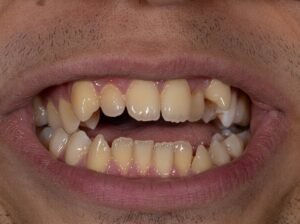
You've probably seen the video. A woman, an offer that sounded too good to be true, and a result that left her unable to even close her mouth. The clip went viral, they mocked her on every social network, and the tag ended up being cruel: "horse teeth."
But here, in practice, what we see isn't a meme. It's someone who came looking for a better smile and left with less confidence than they had before they started.
Quick answer: a smile design goes wrong almost always for the same reason—it was treated as a mechanical procedure, not as a real design. When no one looks at the patient's naturalness, face, and proportions before manufacturing the pieces, the result tends to be artificial: teeth that are too big, too white, too "catalog-like." And no, it's almost never reversible without a second treatment.
In this article, I explain to you, without technical jargon, why this happens, how to spot it in time, and what to do if it's already happened to you.
1. Why the "horse woman" video is not an isolated case
The first thing to say with complete honesty: that video is not an extreme and rare case. It's the most viral version of something that happens every day, to varying degrees, in clinics that promise a perfect smile in record time and at a bargain price.
The pattern repeats itself: promises of express results, prices that don't match the real cost of a good design, and patients who arrive at the chair without really knowing what will be done to their teeth. We've already talked about why cheap in dentistry almost always ends up being very expensive, and smile design is no exception—it is, in fact, one of the treatments where the error is most noticeable, because you literally see it every time you speak or smile.
What almost no one explains to you is that a smile design is not "placing veneers." It's a process where the size, shape, proportion, and position of each tooth are decided in relation to your entire face. When that process is skipped or done halfway, the error isn't in the veneer material—it's in the planning that came before.
And that's exactly where the real problem begins.
2. The root of the problem: when design is delegated to the wrong person
The doctor doesn't design, the technician executes—and that's where the error begins.
Here's something that's rarely said out loud in this industry: poor planning is almost always the origin of a failed design. And that poor planning begins when the doctor trusts the dental technician too much without verifying that the technician has an aesthetic eye.
Because a dental technician is an expert in manufacturing pieces—not automatically a smile designer. The technician is not a designer, unless they are specifically trained to do it. They are two different skills: one is the technical precision to build a strong and functional veneer, and a very different one is the aesthetic sensitivity for that veneer to look like it's always been there.
Without a vision for naturalness, everything tends toward the artificial.
When that aesthetic care is lacking, the result has a very identifiable pattern. If the technician doesn't have the ability to mimic teeth and make them look natural, the tendency is for the teeth to come out very large or very thick—which is, neither more nor less, the "horse teeth" effect that made that video go viral.
It's not that someone wanted to harm you. It's that without a clear vision of what looks natural in a real mouth, the path of least resistance always leads to the same thing: oversized pieces, too white, too uniform. Exactly what in our practice we call the catalog teeth effect: perfect in the photo, fake in real life.
And if you want to see other patterns of bad practice that repeat in this type of treatment, here we break down the three most common ones that we always avoid.
3. The invisible flaw: designing a smile without seeing the patient's face
Here is, perhaps, the most important point of this entire article—and the one that almost no blog about smile design mentions.
If the doctor doesn't provide visual information about the patient's aesthetics to the technician, it's very difficult for the latter to adapt something made by hand, outside the mouth, without having any idea of how the patient looks facially.
Think of it this way: veneers aren't made inside your mouth. They're made in a laboratory, from molds, photos, and (in the best-case scenario) a complete facial analysis. If that information never arrives—or arrives incomplete—the technician is literally designing blind. They don't know if your face is wide or elongated, if your smile is more discreet or broader, if your lips are thick or thin. And all of that determines what size and shape of tooth looks natural on you specifically.
This is the real difference between a smile design done seriously and one done on a production line: how many photos, videos, and facial data points arrived before a single tooth was touched.
4. The 5 physical signs that your smile design went wrong
Not all failed designs are as obvious as the one in the viral video. Many start with more subtle symptoms. These are the signs you should take seriously:
- Teeth visibly large or thick in relation to your lips and face—the most characteristic sign of the "horse effect."
- Persistently inflamed gums, a sign that the veneers were not well-fitted to the gum margin.
- Repeated fractures or chipping of the veneers, often indicating a poor bite adjustment.
- Pain or clicking in the jaw, because modifying the position of the teeth also changes how you close your mouth.
- Extreme sensitivity to cold or heat, generally caused by a more aggressive enamel wear than necessary.
None of these signs is "normal" or something you should learn to live with. They all point to something in the planning—not in your mouth—that failed.
5. Is it reversible? What can be done if it already happened to you
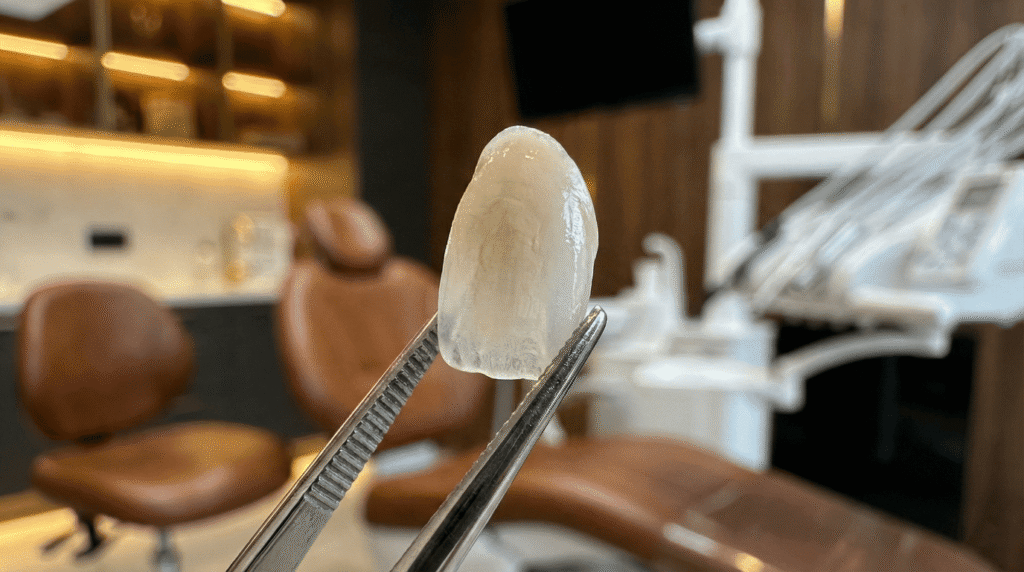
The good news, all things considered, is that in most cases there is a way out—though it's almost never as fast or as cheap as the original treatment that went wrong.
Depending on how much enamel was originally worn down, there are two paths: redesigning on the same teeth (if they still have enough healthy structure) or, in more severe cases, resorting to alternatives like crowns. What never changes is the first step: a complete evaluation, with photos, facial analysis, and an honest conversation about what is truly possible.
It's also normal that after a bad experience, you start obsessively noticing every detail of your smile. If you feel you can't stop finding flaws even after correcting it, it's worth reading about the thin line between seeking to improve your smile and constant dissatisfaction—it's more common than you think, and there's nothing wrong with discussing it openly with your dentist.
And if your current veneers—even if they're not a disaster—are already making you wonder how much longer they'll last, here we break down how long dental veneers actually last based on the material they're made of.
6. How to avoid it from the consultation: the questions you must ask before saying "yes"
Preventing a failed design doesn't depend on luck—it depends on asking the right questions before signing off on the treatment. These are the ones we recommend asking, without fear of sounding demanding:
- Who is going to design my smile: you or the lab? If the answer is vague, that's a red flag.
- Are you going to send photos and video of my smile in motion to the technician, or just the mold? A mold alone is not enough to design naturally.
- Is any analysis of my face done before deciding the size of the teeth? Without this, the design is not personalized—it's standardized.
- Can I see a simulation or mock-up before the final result? Seeing before deciding is your right, not a luxury.
If your current dentist answers these four questions with confidence and detail, you're on the right track. If they raise more doubts than you already had, here we share more clear signs for choosing your dentist with confidence.
Frequently Asked Questions
Can a bad smile design be corrected? Yes, in most cases. The treatment depends on how much enamel was worn down and can range from redesigning the veneers to using crowns.
Why do my veneers look so big? Almost always because they were designed without a prior facial analysis, guided only by a mold and not by how your face looks when you smile.
Is it expensive to correct a failed smile design? It usually costs more than the original treatment, because the damage must first be assessed and sometimes repaired before redesigning.
¿Es caro corregir un diseño de sonrisa fallido? Suele costar más que el tratamiento original, porque primero hay que evaluar y en ocasiones reparar el daño antes de rediseñar.