Do a quick test: close your mouth normally, as if you were going to bite. Now look at your front teeth. Do the upper and lower ones touch, or is there an open space between them even when your mouth is closed?
If there's a gap, you probably have an open bite. And although many people live with it for years thinking it's just "how their teeth are," it has consequences that go quite beyond aesthetics.
Quick answer: an open bite is a malocclusion in which the upper and lower teeth don't make contact when closing the mouth, leaving a visible space. It's not just an appearance issue: it affects chewing, speech, overloads the jaw joint, and prematurely wears down the teeth that do make contact. It can be corrected, but the treatment depends on whether the origin is dental or skeletal—and on a factor almost no one mentions: your tongue.
Let's break this down.
1. Close your mouth: if your front teeth don't touch, this is for you.
An open bite is one of the easiest malocclusions to identify, because it's visible. When you close your mouth, instead of the upper teeth slightly overlapping the lower ones, there's an open space between both arches.
The interesting thing is how many people live with it without knowing it has a name. They get used to cutting food with their molars instead of their incisors, to pronouncing certain words in a particular way, to their jaw bothering them from time to time—and they assume that's just how things are.
They aren't. And understanding what's happening is the first step in deciding whether it's worth correcting.
2. What exactly is an open bite (and its types)
Technically, an open bite is a malocclusion: an alteration in the way the dental arches fit together when closing the mouth. In this specific case, the alteration consists of the absence of contact between teeth that should touch.
There are three main types:
Anterior open bite: the most common and the most visible. The front teeth—incisors and sometimes canines—don't touch, leaving an obvious gap when closing.
Posterior open bite: the space is in the premolar and molar area. It's less visible from the outside, but functionally very relevant because it directly affects chewing.
Complete open bite: combines both, and usually indicates an underlying skeletal component.
It's also key to distinguish its origin, because the entire treatment depends on that: it can be dental—the teeth are poorly positioned or tilted, but the bones are fine—or skeletal—there's an alteration in the growth of the maxilla or mandible. The first is resolved with orthodontics; the second sometimes requires a broader approach.
3. Why it's not just an aesthetic issue: 6 real consequences
Here's the point that almost no article develops, and the reason this topic deserves attention beyond how your smile looks in photos.
Poor chewing. Incisors exist for cutting. If they don't touch, you can't bite into an apple, a sandwich, or a pizza normally—the work is transferred to the molars, which aren't designed for that.
Compromised digestion. A direct consequence of the above: if food isn't ground well, the stomach receives larger pieces and has to work harder.
Speech alterations. Air escapes through the open space when pronouncing certain sounds, which can cause a lisp or difficulty with some phonemes.
Overload of the jaw joint. When the bite is unstable, the temporomandibular joint and its muscles constantly compensate. Over time, this can lead to pain, clicking, and muscle tension—the same condition we explained in why ear and jaw pain usually originates from the bite.
Accelerated wear on the teeth that do touch. If only a few pieces bear the entire chewing force, those pieces wear down much sooner.
Respiratory and facial alterations. Open bite is frequently associated with mouth breathing and, in skeletal cases, with a vertical growth pattern that lengthens the lower third of the face.
None of these consequences is catastrophic in isolation. But together, and sustained over years, they explain why open bite is a functional issue and not a cosmetic one.
4. The tongue: the factor almost no one explains to you
This is the most interesting part of the topic, and where most articles oversimplify.
The tongue plays a leading role in open bite. When you swallow—and you swallow hundreds of times a day, often without realizing it—the tongue should rest against the palate. In some people, however, the tongue gets between the teeth and pushes forward. This is known as atypical swallowing or tongue thrust.
And here comes the honest nuance that is rarely mentioned: there are two theories about this relationship, and it's not always clear which one applies to each patient. Either the tongue generates the open bite by constantly pushing the teeth, or the open bite already existed and the tongue simply occupies the available space. It's a bit of a chicken-and-egg problem.
Why does this distinction matter? Because it determines the long-term success of the treatment. If the tongue is the active cause and that pattern isn't corrected, the teeth will tend to separate again even if orthodontics closed them perfectly. That's the mechanism behind relapse—teeth returning to their original position.
Recommended format: YouTube embed (indexed in Google Videos). Add a brief transcript below for accessibility and indexable text.
5. Where it comes from: habits, genetics, and bone growth
An open bite rarely has a single cause. These are the most frequent ones:
Prolonged childhood habits: extended use of a pacifier or bottle, thumb sucking. If they persist while teeth are erupting, they alter their position and inclination.
Atypical swallowing, which we already covered: the lingual pattern that pushes the teeth when swallowing and often persists into adulthood without the person noticing.
Mouth breathing, frequently associated with nasal obstruction, allergies, or adenoids. Keeping the mouth open for years modifies tongue posture and facial growth.
Genetic and skeletal component: a vertical growth pattern of the maxilla or mandible, which often repeats in the family.
In children, the origin is usually dental or habit-related, which is why it can be successfully intervened in while the bone is still growing. In adults, the skeletal component weighs more, because growth has already finished—but that doesn't mean there's no solution.
6. How it's corrected depending on your case
The good news: open bite has treatment at practically all ages. What changes is the approach.
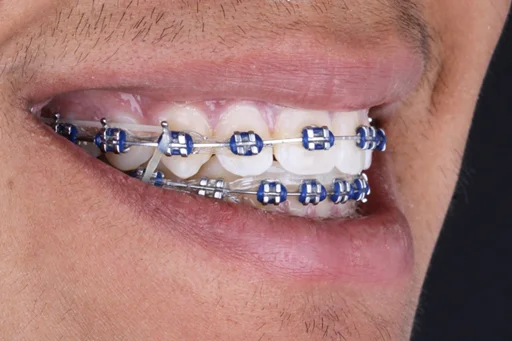
Orthodontics with braces. It remains the most versatile and effective option for repositioning teeth in most dental cases. You can learn more on our page about orthodontics with braces.
Clear aligners. For mild to moderate cases, they allow bite correction in a discreet and removable way, which is especially valued by adult patients. We explain how it works in Invisalign.
Myofunctional therapy. Re-educating the swallowing pattern and tongue posture. It usually accompanies orthodontics when there is tongue thrust, and it is decisive for maintaining the result.
Interceptive orthodontics, in children, taking advantage of the fact that the bone is still developing.
Cirugía ortognática, reservada para casos esqueléticos severos en adultos. Es la excepción, no la regla, y siempre combinada con ortodoncia.
The important thing is that the plan comes from a real diagnosis: clinical examination, X-rays, and analysis of how you're biting and swallowing. Without that, any treatment is a gamble.
7. Why it returns: the part of the treatment that depends on you
We'll finish with the most important thing, and with what is least said in clinics that just want to close the sale.
If you want to maintain the results for life, you have to wear your retainers. They are not optional, they are not "just in case," and they are not only for the first few months. Teeth have memory and tend to go back to where they were, especially when the habit that caused the problem is still there.
But there is something even more important than the retainer, and it's the reason we insist so much on this: the retainer is a reminder, not a magic solution. The greater power is in your mind. We can give you all the distractors and devices in the world, but if you don't make a conscious effort to control the habit—stop pushing with your tongue, correct your swallowing, maintain proper posture—the result won't hold.
It's a conversation we prefer to have before starting, not after. An orthodontic treatment is a considerable investment of time and money, and its long-term success is played out both in the office and in what you do afterward.
What is an open bite? It's a malocclusion in which the upper and lower teeth don't make contact when closing the mouth, leaving a visible space between them.
Is an open bite only an aesthetic problem? No. It affects chewing, speech, overloads the jaw joint, and prematurely wears down the teeth that do make contact.
Can an open bite be corrected in adults? Yes. Depending on the case, orthodontics with braces, aligners, or, in severe skeletal cases, orthodontics combined with surgery are used.
Why does an open bite return after treatment? Mainly due to not wearing retainers and not correcting the habit of pushing with the tongue when swallowing, which continues to separate the teeth.
What does the tongue have to do with an open bite? It can be a cause or a consequence. If the tongue thrusts between the teeth when swallowing, it pushes them and favors the bite opening or relapsing.
AM Dental Studio GDL
¿Tus dientes de adelante no se tocan?
Valoramos tu mordida y te decimos si el origen es dental o esquelético,
y qué tratamiento necesitas realmente.
Diastema: ¿Cerrarlo o lucirlo? La verdad médica 🦷 | AM Dental Studio Diastema Dental: ¿Cerrarlo o Lucirlo? La Verdad Médica Sobre los «Dientes Separados» El
Ya fuiste al médico general. Ya pasaste con el otorrino. Te revisaron el oído, te hicieron pruebas de audición, quizá hasta te mandaron una resonancia.
Buscaste el precio. Encontraste diez respuestas distintas, ninguna clara, y varias que se contradicen entre sí. Un consultorio anuncia carillas por unos pocos miles de
AM Dental Studio GDL
¿Hablamos?
La Dra. Alejandra Mora y su equipo están listos para escucharte.
Cuéntanos tu caso y te responderemos todas tus dudas sin compromiso.