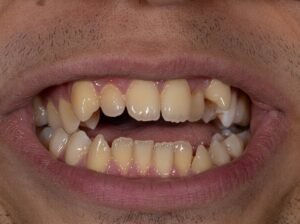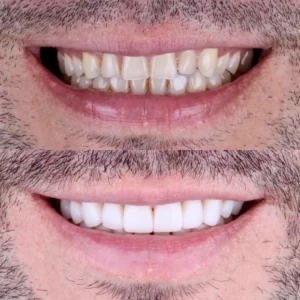
Last week, I sat a patient in my chair who arrived with a signed quote from another clinic: "20 veneers, offer valid only today." They hadn't even taken a single X-ray. Her gums bled upon probing, and her teeth—healthy—were already marked to be prepared.
That's the scene no one shows you in the "before and after" videos. A well-indicated smile design can change the way you see yourself and how others treat you. One done for sales rather than diagnosis can cost you your enamel for life.
That's why I wrote this guide. As I tell my patients: "It can be 10, 100, or 1,000 questions, but the important thing is that you ask, inform yourselves, and with that information in hand, make appropriate decisions." These are the 10 questions I would demand myself if my own mouth were at stake.
" Do I really need a smile design?" — The question many clinics don't want to hear

Not always. Before talking about veneers, a serious clinic evaluates whether you truly need them: there are cases where the ethical answer is "no" or "not yet."
Many people come asking for veneers when what their smile actually needs is whitening, orthodontics, or simply a good cleaning with polishing. The veneer is not a shortcut: it is a prosthetic treatment on teeth that are currently alive and healthy.
At AM Dental Studio, we work like this: it's super important for every patient to have a first appointment where treatments or types of veneers are ruled out, to see which one really suits them. That appointment isn't a sale: it's a clinical filter in your favor.
When you ARE a candidate (and when the ethical answer is "no")
It is usually indicated when:
- There are severe stains that do not respond to whitening.
- There are fractures, wear, or shape alterations.
- The case cannot be resolved with orthodontics, or you decide not to use it, being well-informed.
The ethical answer is "no" (or "not yet") when:
- Your teeth are healthy and only need color or shine.
- There is active, untreated gum disease.
- The result you are expecting is not clinically possible.
What a serious first appointment should include
- Complete medical history and clinical examination.
- Probing and gum evaluation.
- X-rays and study photographs.
- Mock-up or digital design with no commitment.
- Alternatives explained with pros and cons.
- Itemized quote with no pressure to sign.
If you don't have one yet, schedule your first evaluation appointment before signing anything. And a heads-up: if there's a wedding on the calendar, timing changes everything.
But before deciding, there's one question almost no one asks… and it's the most important one of all.
"What are they going to do to my natural teeth?" — The question of irreversible wear
Some veneers require enamel filing, and enamel does not regenerate: what is prepared today won't come back tomorrow. You need to know exactly what will be done to your teeth before accepting.
In plain language: for certain veneers to fit and look natural, sometimes a fraction of the tooth must be reduced. When well-indicated and well-executed, this wear is minimal and predictable. The problem is aggressive or unnecessary wear, done out of routine rather than indication.
Ask without hesitation: are you going to prepare my teeth?, how many millimeters?, in which cases would you NOT prepare them? A clinician with judgment will answer you with numbers and examples.
Red flag: the clinic that prepares every case the same way. Every mouth requires a different preparation—or none at all.
Un diente tallado es un diente comprometido para siempre. Esa frase debería estar en la pared de todas las clínicas estéticas.
When the answer is "we don't need to prepare" and they justify it with your case on screen, you're seeing good judgment. When the answer is vague, keep reading: the material matters as much as the wear.
"What type of veneers do you recommend and why?" — The question of material
There are two main families—porcelain and composite—and the correct choice depends on your case, not the clinic's inventory.
Look at it straight on:
| Criteria | Porcelain | Composite |
|---|---|---|
| Durability | 10-15 years | 5-7 years |
| Aesthetics | Very high and stable | High, can stain |
| Repair | Replacement if fractured | Repairable in the office |
| Maintenance | Hygiene + check-ups | Periodic polishing |
| Initial cost | Higher | Lower |
And beware of "low-cost packages": they often hide industrial materials, uncertified labs, and shortened chair time. A low price always comes at a cost; the question is where.
Demand a justification: why that material for my case and not the other? The correct answer mentions your bite, your enamel, your habits, and your budget. The bad answer is "it's the one we use for everyone."
I explain it in depth, with real cases, in real differences between porcelain and composite veneers.
But even the best material can't save a bad plan. And the plan is made by a person: that's the next question.
"Who diagnoses me and who places the veneers?" — The team question
You have the right to know the name, surname, and experience of who will touch your teeth: in many packages, the one who sells you is not the one who treats you.
In aesthetic dentistry, several actors are involved: the person who diagnoses, the one who prepares the teeth, the one who cements the veneers, and the laboratory that manufactures them. When those links are broken or rotate, the result suffers.
Ask naturally:
- Who will make my diagnosis and my treatment plan?
- What training do they have in aesthetic dentistry?
- How many cases like mine do they solve per month?
- What laboratory will manufacture my veneers?
Aesthetic dentistry is not an assembly line. Your smile is designed by a person with clinical judgment and trained hands, not a rotating shift. If in the consultation you can't put a face to your doctor, that's already an answer.
And with a face and a name, we move on to what everyone looks at first: the price.
"How much does it really cost and what does it include?" — The total price question
A serious quote is itemized in writing: number of pieces, material, laboratory, temporaries, adjustments, and maintenance. If they only give you a closed price, ask for the details.
The most frequent hidden costs are temporaries, adjustment appointments, prior whitening to match color, and subsequent check-ups. None of that is a "surprise extra" in a serious clinic: it's part of the plan and is explained to you beforehand.
Be wary of a price that doesn't even cover the cost of the laboratory, in Guadalajara or in any city: the difference is cut from material, time, or follow-up. And ask about the warranty: what it covers (fracture, debonding, color), for how long, and under what conditions.
If you're already comparing serious options, here's how we work on smile design in Guadalajara at AM Dental Studio: diagnosis first, itemized quote always.
Warranty, maintenance, and the fine print
A veneer lasts as long as its maintenance: hygiene, check-ups, and habits. And habits weigh more than you think: when the holidays come, that's how alcohol, sugar, and wine affect your smile. Maintenance is also decided at the table.
Before the material and the price, however, there is a foundation that no one sees and everyone pays for: your gums.
"What if I have inflamed gums?" — The health question almost no one asks
No aesthetics are done on diseased gums: periodontal health comes first, and a clinic that places veneers over active periodontitis is putting you at risk.
Imagine your gums as the foundation of a house: you can put the world's best finish on it, but if the foundation gives way, everything comes down. Gums that bleed when brushing are inflamed gums, and on inflamed gums, the margin of a veneer never seals well: aesthetic and biological failure guaranteed.
The correct order is non-negotiable: periodontal treatment → reevaluation → aesthetic planning → veneers. Any shortcut in that chain is a bill that comes later, with interest.
It's not a minor detail: periodontal disease affects a large portion of adults and often goes unnoticed until it's too late, as documented by health organizations like the CDC on periodontal disease.
What if, at the end of the diagnosis, it turns out you don't need veneers to achieve what you're looking for?
"Are there more conservative alternatives?" — The question of options
Yes, and in many cases they are the correct answer: orthodontics, professional whitening, or simply not touching the tooth can achieve your result without wearing it down.
In my practice, the compass is simple: from the options that suit you, the most conservative for your teeth. That's the one I propose first, even if sometimes it bills less.
- Clear aligners to align and close gaps without touching enamel.
- Professional whitening when the problem is only color.
- Mock-up or digital design to "test" your smile before deciding on anything.
If your case is about separated teeth, a diastema: close it or flaunt it? I'll tell you why I prefer to close them with clear aligners whenever the treatment allows it: periodontal health and long-term stability thank you for it.
Aesthetics that age well are those that respect biology. And biology is proven with facts, not filters: let's move on to the test.
"Can I see real cases, with photos?" — The test question
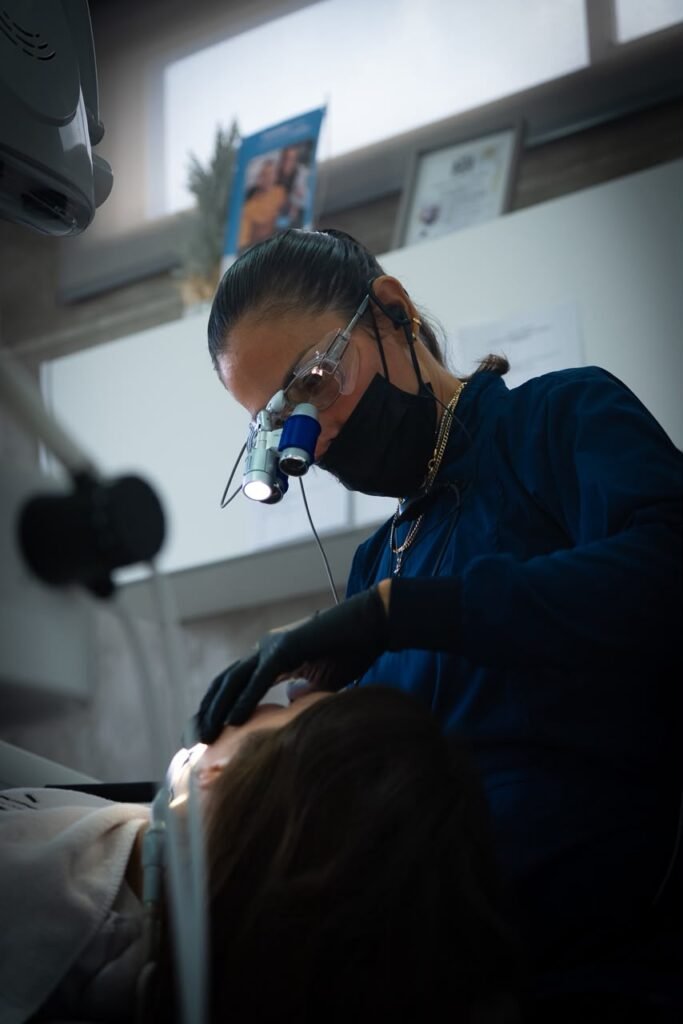
Ask to see before and after photos of real cases similar to yours: a clinic with experience has no problem showing its work.
Pay attention to what truly reveals quality:
- Gum integration: the margin should look healthy, not red or retracted.
- Naturalness of color: uniform "chewing gum" white is a signature of industrial work.
- Variety of cases: different mouths, different ages, different starting points.
- Continuity: the same mouth in before and after, with real lighting, not stock or filter.
And read reviews paying attention to one detail: how the clinic responds to criticism. That's where you see the team's character much more than in the praise.
If they only show you videos with music and no clinical photos, you already have a clue. And with that clue, close with the last question: the one that saves you the trouble.
3 signs to walk out of that consultation today
If they pressure you with a "today-only" discount, promise you perfect teeth without examining you, or can't answer these 10 questions, stand up and seek another opinion.
- Artificial urgency: "the offer expires today." Your mouth has no expiration date; the salesperson's commission does.
- Zero diagnosis: no X-rays, no gum probing, no study photos, and they already mentioned 20 veneers.
- One-size-fits-all answer: the same package, the same material, and the same price for completely different mouths.
- Nothing in writing: no itemized quote, no warranty, no maintenance plan.
In the end, my advice is the same one I give in the chair: with the information in hand, make the right decision based on the results you want to achieve. Your smile is not a flash sale.
And if after these 10 questions you decide that AM Dental Studio is your place, we'll welcome you with the same clinical filter as always: diagnosis first, sale after.
Frequently Asked Questions
Does smile design damage teeth? Only if healthy teeth are prepared without clinical justification. That's why a conservative diagnosis is key: sometimes the best option is not to touch the tooth.
How long does a smile design last? Well-maintained porcelain veneers last between 10 and 15 years; composite ones, between 5 and 7. It depends on the material and your hygiene.
How many veneers are needed for a smile design? It depends on your visible smile: usually between 8 and 10 upper pieces. Be wary of anyone who sells you 20 without evaluating your case.
Does getting a smile design hurt? No: it's done with local anesthesia, and any post-operative discomfort is mild and temporary. What's relevant is the prior diagnosis, not the pain.
Can I choose the color and shape of my veneers? Yes: the design is agreed with you through a mock-up or digital design before touching your teeth. You approve the result before deciding.