You typed "black line veneers" into Google in the middle of the night, didn't you? And the first thing you found was a scare: photos of metal crowns peeking through the gumline, words like "emergency" and "irreparable damage." You closed the search more worried than you were before you opened it.
Here's the good news that almost no one gave you: if you have porcelain or resin veneers (not crowns with a metal base), that line is almost always not a failure—it's normal dental physics.
Quick answer: between your natural tooth and the veneer, there is always an interface. Over time, that interface—made of resin cement—tends to pigment slightly because resin, by its composition, has the ability to absorb color. A good dentist hides it at the time of preparation, but without overdoing it: hiding it too deep, at the subgingival level, brings other kinds of problems.
Let's break this down calmly, without unnecessary technical jargon.
1. Before you panic: what that black line really is
Here, in practice, we see patients arrive with the same worried look after doing their own research. And in most cases, when we check, there's nothing broken or poorly done.
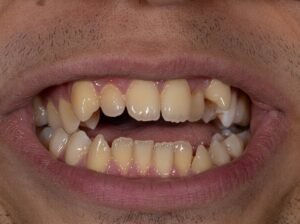
What you're seeing is the cement interface: the very thin line of resin that bonds your natural tooth to the veneer. It's not a gap, not dirt, not a veneer coming off. It's literally the glue that makes the veneer stay there.
And like any interface, it has a characteristic that very few explain clearly: over time, it tends to darken a little. Not because something went wrong, but because that's how the material behaves.
2. The mistake almost all of the internet makes: confusing veneers with metal crowns
Here's why your search scared you so much: almost everything you'll find in Spanish about "black line" is talking about crowns or caps with a metal base, not modern porcelain or resin veneers.
These are two completely different situations. In a metal-ceramic crown, when the gum recedes over time, what shows is the edge of a metal structure that was hidden under the porcelain—that is indeed an aesthetic problem that usually requires replacing the piece. In a well-made porcelain or resin veneer, there is no metal. What you see is only the cement interface, and its behavior is different.
The problem is that most blogs and videos out there mix both cases as if they were the same, and that creates an alarm that often doesn't match your real situation. Before assuming the worst, it's worth understanding what type of restoration you have—something you can review in detail in how long dental veneers actually last according to their material.
3. Why the interface pigments over time

Let's get to the point that almost no one explains with clinical honesty: there is always an interface between the veneer and the tooth—always. There is no such thing as a veneer that "doesn't have a line," because physically it needs a bonding point.
That interface, over time, tends to pigment—it's normal, because it's resin, and resin has a significant capacity for pigmentation. Just like a white cup slowly stains with coffee even if you wash it every day, the resin cement has microscopic porosity that, over years of exposure to natural dietary pigments (coffee, wine, tea, even certain foods), takes on a darker tone.
This doesn't mean the veneer is failing. It means the material is doing exactly what is expected after several years in the mouth.
That's why, in treatment planning, we try to hide that interface at the time of preparation—placing it at a point where it's as least visible as possible even when it eventually darkens a little.
4. The line a good dentist never crosses
Here is where honesty matters more than at any other point in this article, because there is an easy temptation: if the solution is to "hide the line," then why not hide it as deep as possible and be done with it?
Because you shouldn't hide it so much that the line becomes subgingival—that is, below the gum margin—because if you do, it brings other problems.
When the veneer preparation is extended too far down below the gingival margin, trying to "disappear" the margin at all costs, it invades a biological space that the gum needs to stay healthy. The result, over time, can be exactly the opposite of what was intended: chronic inflammation, bleeding, gum recession, and in some cases, the exposure of the very line that was meant to be hidden—now with an added periodontal problem.
Es el mismo principio que ya hemos hablado antes en el blog: el equilibrio entre la estética y la salud real de la boca siempre debe inclinarse hacia la salud primero.
5. When it IS a real warning sign
Not everything you see there is normal, and it would be equally irresponsible to tell you never to worry. These are the signs that do warrant a check-up:
- The line appears suddenly and very prominently, when it wasn't there before—this could indicate leakage or a poorly fitted veneer.
- It's accompanied by gum bleeding or inflammation, which suggests a periodontal problem, not just an aesthetic one.
- You feel sensitivity or discomfort in the area, a sign that something more is going on beneath the veneer.
- The gum looks receded and progressively shrinking, which can expose more of the margin than originally planned.
- You have old crowns or caps with a metal base (not veneers), in which case the line does correspond to the mechanism of metal exposure.
If you notice any of these signs—and not just the line itself—it's time for an evaluation. You can read more about how to identify when an aesthetic treatment has begun to compromise your health in effects of veneers on patients: 100% real expectations.
6. What to do if you're concerned about yours
If after reading this you still have doubts about your particular case, you don't need to resign yourself to "living with uncertainty," nor do you need to rush to get your veneers replaced unnecessarily.
What we do recommend is asking your dentist directly two very specific things: how deep was the preparation at the gumline margin? and has the line I see changed in the last few months, or has it always looked the same? The answers to these two questions usually clarify immediately whether you're dealing with something expected or something that does require attention.
And if your underlying concern is more general—whether the dentist you chose is making the right decisions for you—we share clear signs for choosing your dentist with confidence.
Frequently Asked Questions
Is it normal for my veneers to have a dark line at the gumline? Yes, in most cases. It's the cement interface, which over time tends to pigment slightly due to the nature of the resin.
How can I tell if my black line is normal or a problem? If it appeared gradually and there is no bleeding, inflammation, or sensitivity, it's usually normal. If it's sudden or accompanied by discomfort, you need an evaluation.
Is the black line on veneers the same as on metal crowns? No. In metal-ceramic crowns, the line is usually the exposed metal edge due to gum recession; in porcelain or resin veneers, there is no metal involved.
Can the black line on veneers be completely avoided? Not entirely, because there is always a bonding interface. Its visibility can be minimized with careful preparation that does not invade the biological space of the gum.