" It has to come out." Three words many patients hear at the first consultation, almost always accompanied by an implant quote. And since the tooth hurts and fear weighs heavily, most say yes. What almost no one asks before extracting a tooth is the most important thing: can it really not be saved?
I'll tell you straight: many of the teeth that are extracted every day could be saved. A scientific review that compared dozens of studies found that a well-restored root canal-treated tooth and an implant have practically the same long-term survival: around 94% versus 96%. The difference is minimal. What isn't minimal is losing a tooth that was yours.
At AM Dental Studio we work with a very simple idea: we take care of what you have and recover what you've lost, in that order. I'll explain when a tooth can be saved, when it really has to be extracted, and what to ask before accepting that they take it out.
In this article
Can a tooth that "has no remedy" be saved?
Many times, yes. A deep cavity, an infected nerve, an abscess, or a tooth broken in the visible part often have a solution with root canal treatment and a good reconstruction. What determines whether it can be saved isn't the pain, but how much healthy structure and how much bone is left.
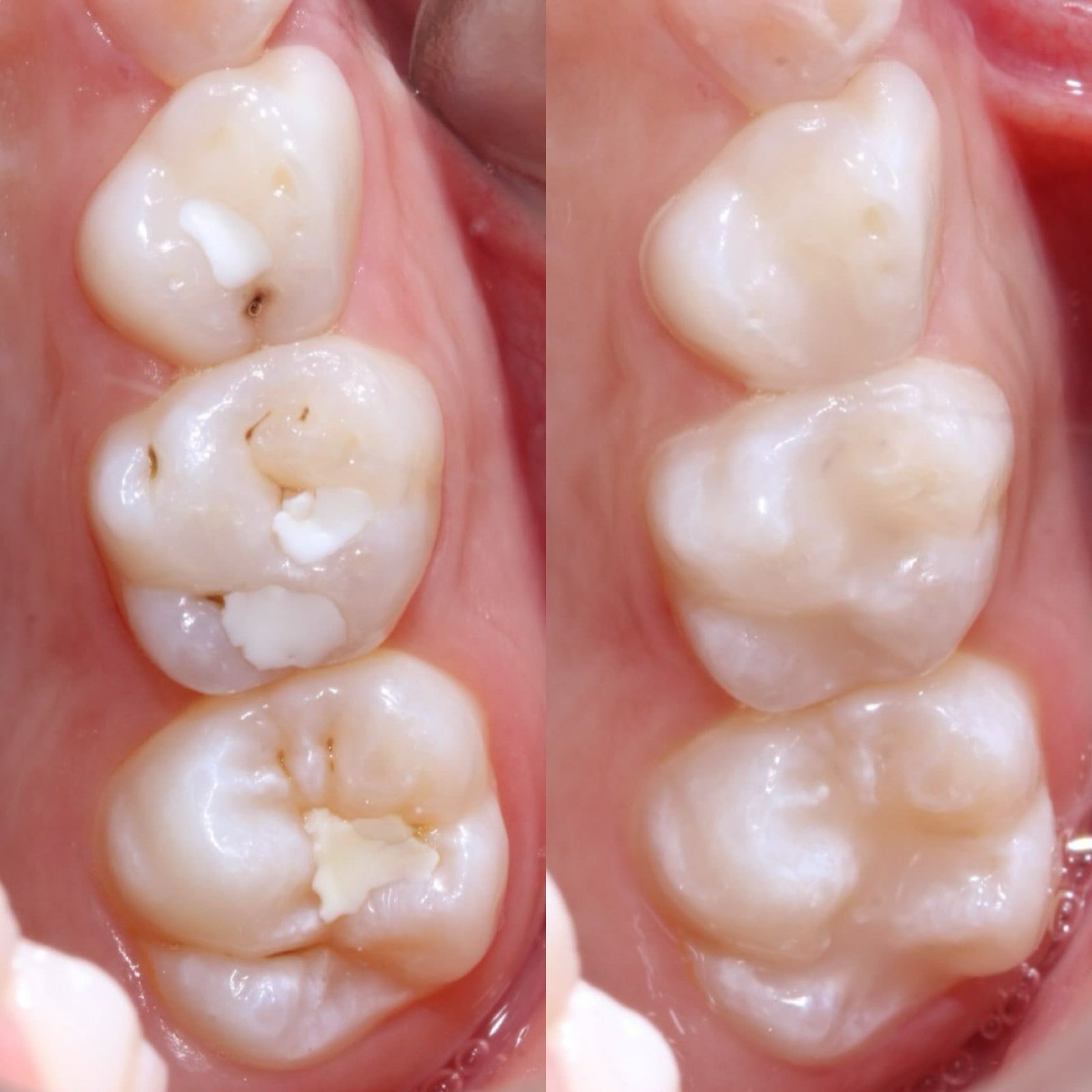
The most common mistake is thinking that a tooth that hurts a lot is a lost tooth. It isn't. Intense pain usually comes from the nerve, and the nerve can be treated: that's exactly what a root canal does. The inside of the tooth is cleaned, disinfected, sealed, and the tooth stays in your mouth, supported by its own root.
Lo mismo pasa con muchos dientes que se ven «destruidos». Si debajo de la encía queda suficiente raíz sana y el hueso que la rodea está firme, el diente se puede reconstruir con un poste, una restauración o una corona. Nosotros lo explicamos a fondo en por qué a veces el diente necesita más corona para salvarse.
| Lo que te dijeron | ¿Se puede salvar? | Tratamiento habitual |
|---|---|---|
| «La caries llegó al nervio» | Casi siempre | Endodoncia y reconstrucción |
| «Tienes un absceso» | Muchas veces | Endodoncia; el hueso suele recuperarse al eliminar la infección |
| «Se te rompió la muela» | Si la fractura no baja a la raíz | Incrustación o corona |
| «La endodoncia anterior falló» | A veces | Retratamiento de conductos |
| «El diente se mueve» | Depende del hueso | Tratamiento de encías y control |
| «La raíz está partida a lo largo» | Casi nunca | Extracción y reemplazo |
To decide, we need to see what can't be seen: an X-ray and, in doubtful cases, a CT scan, which shows the root and bone in 3D. Without those studies, no one should tell you "it has to come out" with certainty.
Now, the question everyone asks me: if an implant ultimately "lasts longer," why go through the trouble of saving the tooth? The numbers tell a different story than marketing does.
Root canal or implant: what the numbers say
A well-restored root canal-treated tooth and an implant have a very similar long-term survival: around 94% and 96%. But a natural tooth preserves something no implant has: the ligament that cushions and feels the bite.
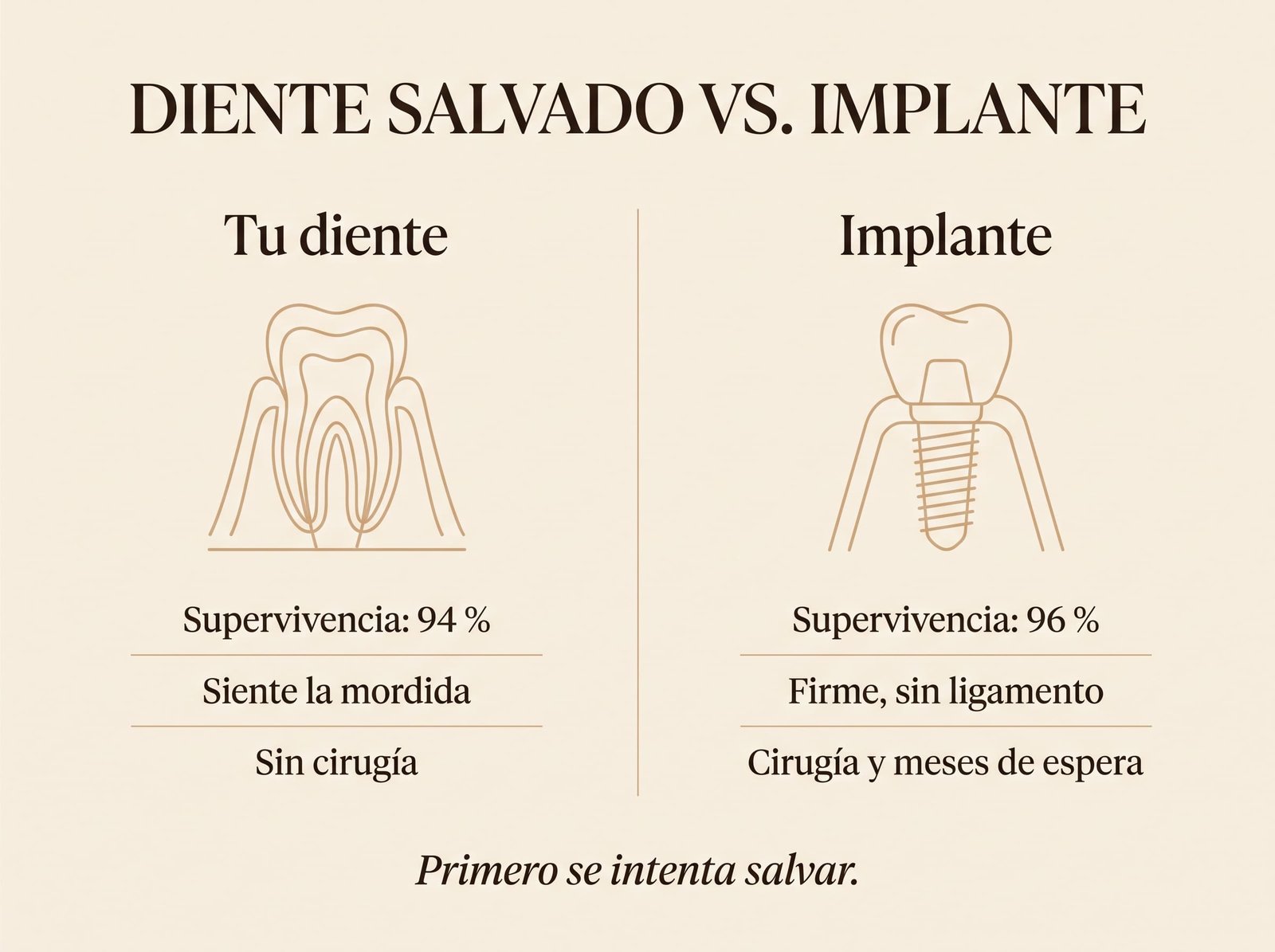
In 2008, a group of researchers compared 24 root canal studies and 46 single-implant studies. Their conclusion was clear: long-term survival is similar. There are variations depending on the study and follow-up time, but the difference is small. In other words: saving the tooth isn't "the weak option."
And there's something the figures don't show. Your tooth is attached to the bone by a periodontal ligament, a tissue that works as a shock absorber and a sensor: it warns you when you bite too hard or when there's something hard in your food. An implant, on the other hand, is fixed directly to the bone. It works very well, but it doesn't feel the same.
| Aspect | Diente con endodoncia | Implante |
|---|---|---|
| Supervivencia a largo plazo | ≈ 94 % | ≈ 96 % |
| Sensación al morder | Natural, con amortiguación | Firme, sin ligamento |
| Cirugía | No | Sí, y a veces injerto de hueso |
| Tiempo total | Días o pocas semanas | Varios meses |
| Principal riesgo | Fractura si no se protege con una buena restauración | Inflamación alrededor del implante (periimplantitis) |
That last point deserves attention. Implants aren't eternal or immune: a 2022 review estimated that about 1 in 5 patients with implants develops peri-implantitis, an inflammation that can cause the loss of the bone supporting them. We explain it in why a dental implant can fail.
I'm not telling you this to scare you away from implants. In our clinic we place them every day and they change lives. I'm telling you because an implant is the best solution when the tooth can no longer be saved, not a shortcut to avoid trying. As I sum it up in the office: nothing will replace the naturalness of a tooth.
So, if the numbers are so even, why do so many people leave the office with an extraction scheduled?
Why do they recommend extraction so quickly?
For several reasons: it's faster, more predictable for the one doing it, sometimes more profitable and, often, the patient themselves asks for it out of fear of the root canal. None of those reasons has to do with what's best for your mouth in the long term.
Let's be honest, because that's the idea of this blog. Extraction is a quick procedure, and the implant that usually follows is a higher-cost treatment. In a market where some clinics work by volume, the recommendation to "take it out and place an implant" can come before a complete diagnosis. We talk about this bluntly in dental overtreatment: why they recommend things you don't need.
But not everything is the dentist's fault. Many patients come asking for the extraction because they're terrified of the root canal. "Just pull it out, I don't want it to hurt." It's a myth that comes from decades ago. Today a root canal is done with anesthesia and feels very similar to a normal restoration. What hurts is the infected tooth before the treatment, not the treatment.
What you lose when a tooth is extracted
- Bone: after an extraction, the bone in the area begins to shrink. In the first year it can lose around half its width, and most of that happens in the first few months.
- Stability of the neighboring teeth: they shift toward the gap, and the one in front can "drop" or "rise" looking for contact.
- Time: an implant requires surgery, months of integration and, sometimes, bone grafting.
- Natural feeling: the cushioning of the periodontal ligament doesn't come back.
That's why, for me, extraction is the last option, not the first. As I always say: the idea is to save teeth and do whatever treatments are necessary to keep them in the mouth for as long as possible.
Now, being honest also means saying the opposite: there are cases where insisting on saving a tooth is the mistake.
When extraction really is the best decision
When the root is fractured lengthwise, when there isn't enough structure left to rebuild, when bone loss is severe, or when the tooth puts the neighboring ones at risk. In those cases, prolonging the inevitable costs more.
Saving a tooth at all costs isn't good dentistry either. There are situations where the prognosis is so poor that each additional treatment only delays the extraction, costs money, and, in the meantime, the infection keeps damaging the bone you'll later need for an implant.
| Situation | Por qué |
|---|---|
| Fractura vertical de la raíz | No se puede sellar ni reparar de forma predecible |
| Caries que llegó muy por debajo del hueso | No hay dónde apoyar una restauración |
| Pérdida ósea avanzada con movilidad | El diente ya no tiene soporte |
| Infección que no cede tras retratamiento | Sigue destruyendo hueso |
| Muela del juicio que daña a la vecina | El problema crece con el tiempo |
Regarding wisdom teeth, by the way, there's no universal rule either: not all of them have to be removed. We explain it in do wisdom teeth always have to be extracted?
When extraction is truly necessary, the important thing is to plan the replacement from the start. Leaving the gap "for later" allows the bone to shrink and the neighboring teeth to shift. In those cases, dental implants are a great solution, and with good maintenance they last for many years. If you're wondering how many, we cover it with real cases here: how long implants actually last.
How do you know whether you're in one case or the other? By asking the right questions before saying yes.
Before saying yes: the questions you should ask
Ask to see the X-ray, ask what would happen if you try to save it and what its prognosis is with a root canal. A good specialist explains why a tooth can't be kept, not just that it has to come out.

An extraction is irreversible. That's why it's worth taking a few minutes to understand it. These are the questions I recommend you ask, and which at our clinic we answer before any decision:
- "Can you show me on the X-ray why it can't be saved?" You should see the fracture, the lack of bone, or the deep cavity, not just hear about it.
- "What would happen if we try a root canal?" Ask about the prognosis: high, doubtful, or poor.
- "Do I need a CT scan?" In doubtful cases, it shows fractures and bone that the X-ray can't see.
- "What happens to the gap afterward?" If the tooth is extracted, the replacement plan should exist from that day on.
- "Can I take a few days to decide?" Unless it's a real emergency, the answer should be yes.
Be wary too of quotes that arrive before the diagnosis. If at the first appointment, without an X-ray, you already have the quote for extraction, graft, and implant in your hand, the decision was made too quickly. Diagnosis comes first; then the plan.
And if you have doubts, get a second opinion. A professional who is confident in their diagnosis won't be offended. If you're interested in knowing how to recognize a good dentist, we have a guide: how to know if you've found a good dentist.
At AM Dental Studio the order is always the same: first understand the tooth, then try to preserve it, and only at the end replace it. Because, as I say at every appointment, nothing will replace the naturalness of a tooth.
Did they tell you a tooth has to be taken out and you're not sure? Schedule an evaluation. We review your studies and tell you honestly whether it can be saved.
Frequently Asked Questions
¿Es mejor una endodoncia o un implante?
Si el diente se puede restaurar bien, conservarlo con endodoncia suele ser la mejor opción: su supervivencia a largo plazo es muy similar a la de un implante.
¿Cuándo es obligatorio extraer un diente?
Cuando la raíz está fracturada a lo largo, no queda estructura para reconstruir, hay pérdida de hueso severa o la infección no cede tras el tratamiento.
¿Duele una endodoncia?
Con la anestesia actual, se siente muy parecido a una restauración normal. Lo que duele es el diente infectado antes del tratamiento.
¿Qué pasa si me sacan un diente y no lo reemplazo?
El hueso de la zona se reduce y los dientes vecinos se mueven hacia el hueco, lo que complica la mordida y un futuro implante.
¿Puedo pedir una segunda opinión antes de una extracción?
Sí. Salvo una urgencia real, tienes derecho a revisar tus estudios con otro especialista antes de una decisión irreversible.

Sources consulted
- Initial endodontic treatment vs single-tooth implants: survival (Torabinejad et al., 2008) — UT Health San Antonio CAT
- Prevalencia de periimplantitis: revisión y metaanálisis (2022) — The Dental Elf
- Cambios del reborde alveolar tras una extracción (Schropp et al., 2003) — Journal of the Canadian Dental Association
This article is for informational purposes and does not replace a personalized clinical evaluation.