When you were nine, you fell off your bike and hit one of your front teeth. It hurt for a couple of days, gave you a little sensitivity, and you forgot about it. Fifteen years later, in a photo, you notice it: that tooth looks grayer than the others. It doesn't hurt. It doesn't bother you. That's why almost everyone lets it go, and that's why it's dangerous.
Dental impacts are much more common than they seem. A global analysis published in 2018 estimated that about 15% of people have had an impact on a permanent tooth and more than 20% on a baby tooth. We're talking about some 900 million people worldwide. Many of those teeth, years later, change color.
A dark tooth after an impact doesn't have an aesthetic problem. It has a problem on the inside. Let me explain what's happening, why the silence is the most misleading part, and what can be done to save it and restore its color.
In this article
Why does a tooth turn gray after an impact?
Because the impact damaged the blood vessels and the nerve that feed the tooth. The internal tissue dies (necrosis) and, over time, its remains pigment the tooth from the inside, making it look gray, brown, or almost black.
Inside each tooth there is living tissue called the pulp: a bundle of blood vessels and nerves that enters through the tip of the root. That bundle is extremely thin. When the tooth takes an impact, it can tear or become strangulated at that entry point. As I explain in the office: with trauma, the neurovascular bundle dies suddenly, and from that point on the tooth is left without nutrition.
What follows is a slow process. The dead tissue decomposes inside the canal and releases pigments that seep into the dentin, the layer beneath the enamel. Since enamel is semi-transparent, that color shows from the outside. It can take months or years to become noticeable. That's why many people no longer connect the color to that childhood impact.
Not all colors mean the same thing
| Color | Qué suele indicar | What to do |
|---|---|---|
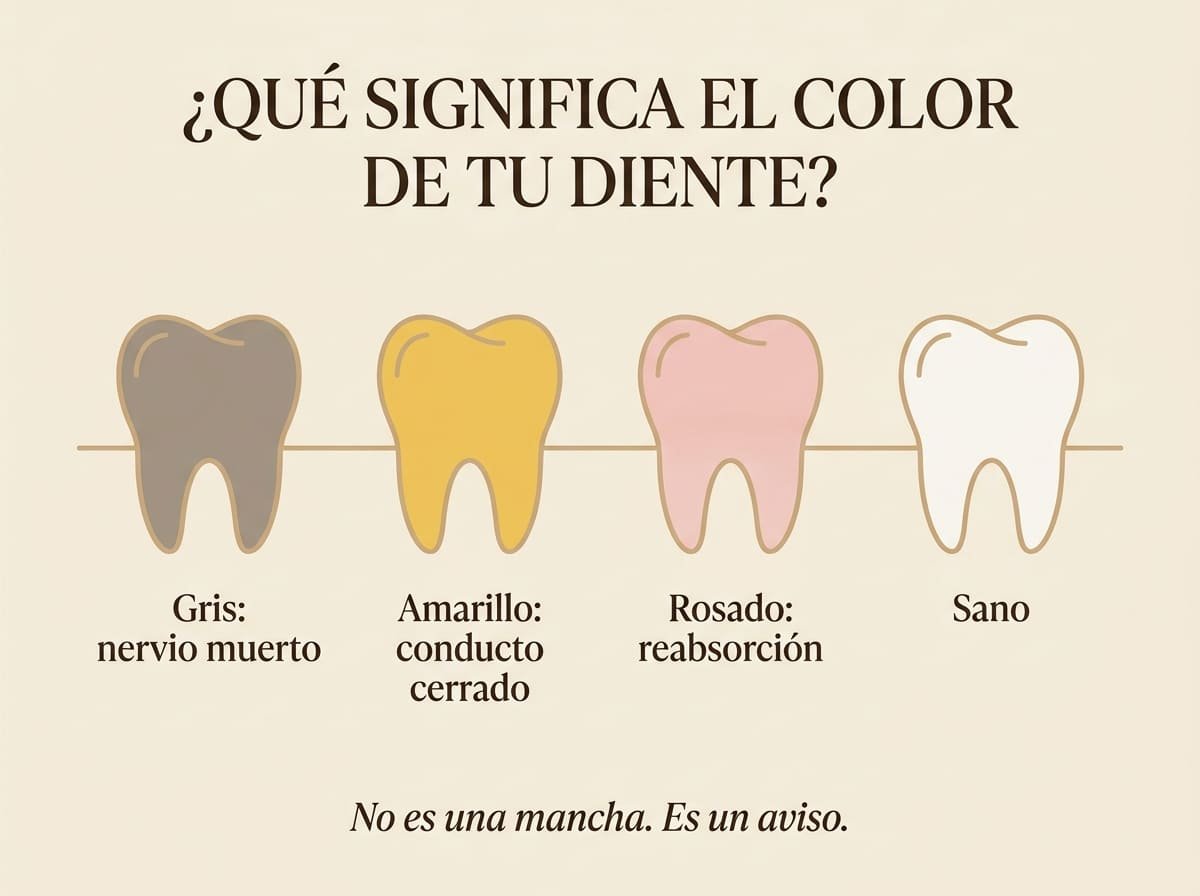
| Gris, café o negruzco | Muerte del nervio (necrosis pulpar) | Valoración pronto |
| Amarillo más intenso | El diente se defendió cerrando su conducto con tejido duro | Vigilar con radiografías |
| Rosado | Posible reabsorción interna del diente | Valoración pronto |
| Gris en un diente de leche | A veces se recupera; a veces hay necrosis | Revisión y seguimiento |
Gray is the most common and the most ignored. And it's not a stain that comes off with a cleaning: it's the sign that the tooth died on the inside. What happens next depends on how long you leave it that way.
"It doesn't hurt": why silence is the most dangerous thing
Because a dead nerve can no longer hurt. The infection can advance in silence toward the root bone and form abscesses or cysts, until the tooth is lost. The lack of pain doesn't mean it's healthy.
Here's the trap. Most people use pain as an alarm: if it doesn't hurt, nothing's wrong. With a tooth that took an impact, the opposite happens. As I describe it in the office, at first the patient only notices some sensitivity, then nothing, and over the years the tooth starts to darken. That's when they realize something bad was happening.
That "something bad" is that the tooth died and the necrotic tissue is still inside the canal. A canal with dead tissue is an ideal place for bacteria. Over time, the infection can spread out through the tip of the root and affect the bone.
What can happen if you leave it
- Abscess: a pocket of pus in the bone, which can appear suddenly with pain and swelling.
- Fistula: a little "bump" or pimple on the gum that comes and goes, and where the infection drains.
- Bone loss around the root, visible only on an X-ray.
- Progressive darkening, increasingly difficult to reverse.
- Tooth loss if the infection destroys too much support.
The good news: if treated in time, a dark tooth can almost always be saved. The key lies in something almost no one does after an impact.
After an impact: the follow-up almost no one does
Every tooth that takes a strong impact should be checked and monitored for months, even if it looks fine. Vitality tests and X-rays detect necrosis before the tooth changes color.
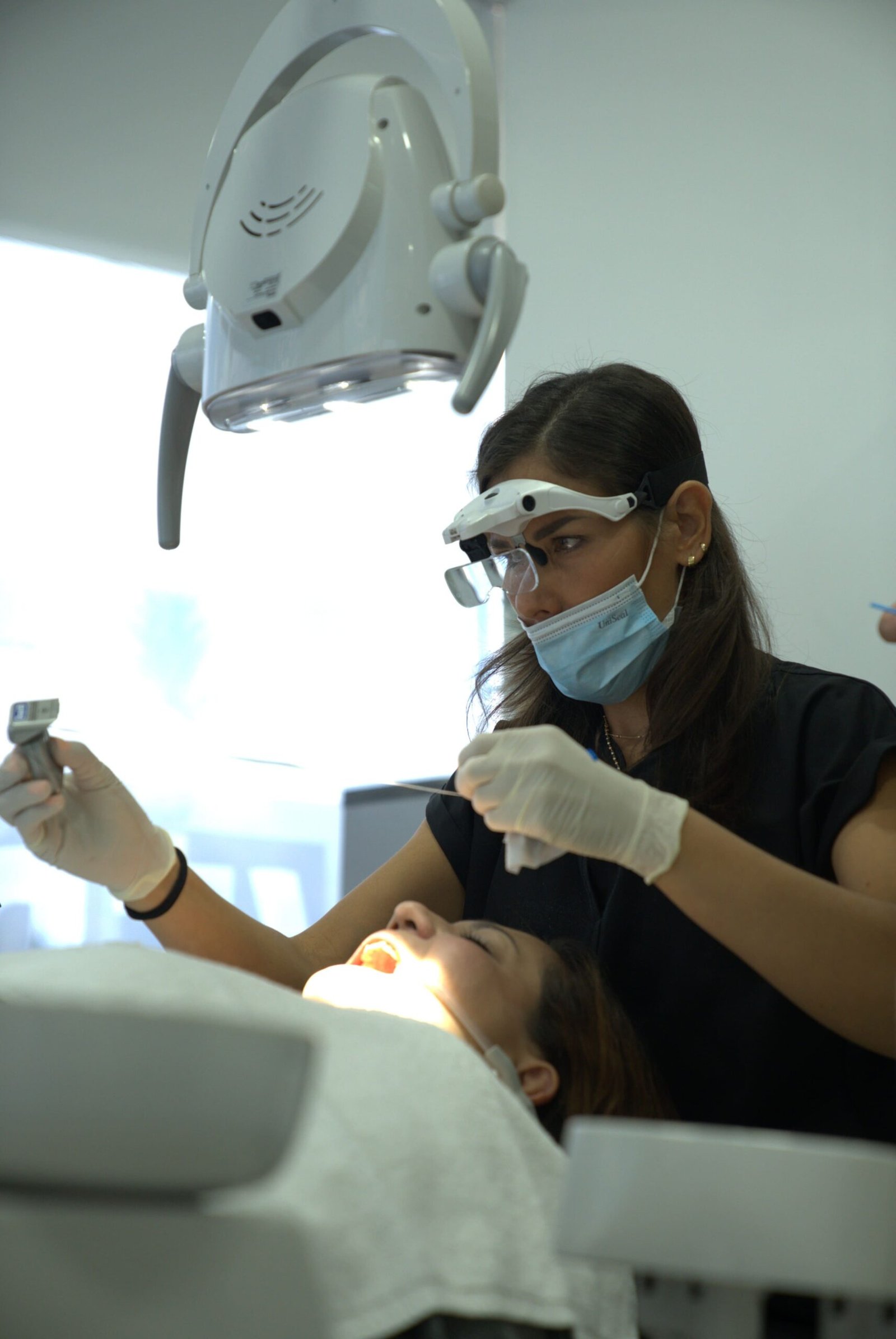
This is the part I most want you to take away. Those teeth have to be kept under observation. An impact doesn't end when the pain stops. The nerve can die weeks or months later, and the only way to know in time is to have it checked.
International dental traumatology guidelines recommend scheduled follow-ups after an impact: in the first weeks, a few months later, at one year, and in some cases for several years. At each check-up we review the color, the nerve's response, mobility, and the root X-ray.
- The day of the impact or in the following days: check-up and baseline X-ray.
- In the first weeks: nerve response test and gum check-up.
- A few months later: a new X-ray to see if the root and bone are healthy.
- At one year: color and response check.
- Afterward: periodic check-ups if the impact was strong or there was displacement.
If you play contact sports or your children play soccer, basketball, or martial arts, a custom mouthguard prevents a good share of these impacts. It's much simpler to prevent than to treat a necrotic tooth.
And what if it was in a baby tooth?
It's very common for a baby tooth in children to turn gray after a fall. Sometimes the color improves on its own over time; other times there's necrosis and infection appears. Since the permanent tooth is forming right underneath, it's worth having a dentist check it instead of waiting for it to "fall out on its own."
And what if the tooth is already dark and years have passed? There's still a lot that can be done.
The treatment: root canal and internal whitening
First, a root canal is done to clean out the dead tissue and seal the canal. Then, internal whitening lightens the tooth from the inside. If the color doesn't come out well or comes back, a veneer or a crown is the next option.
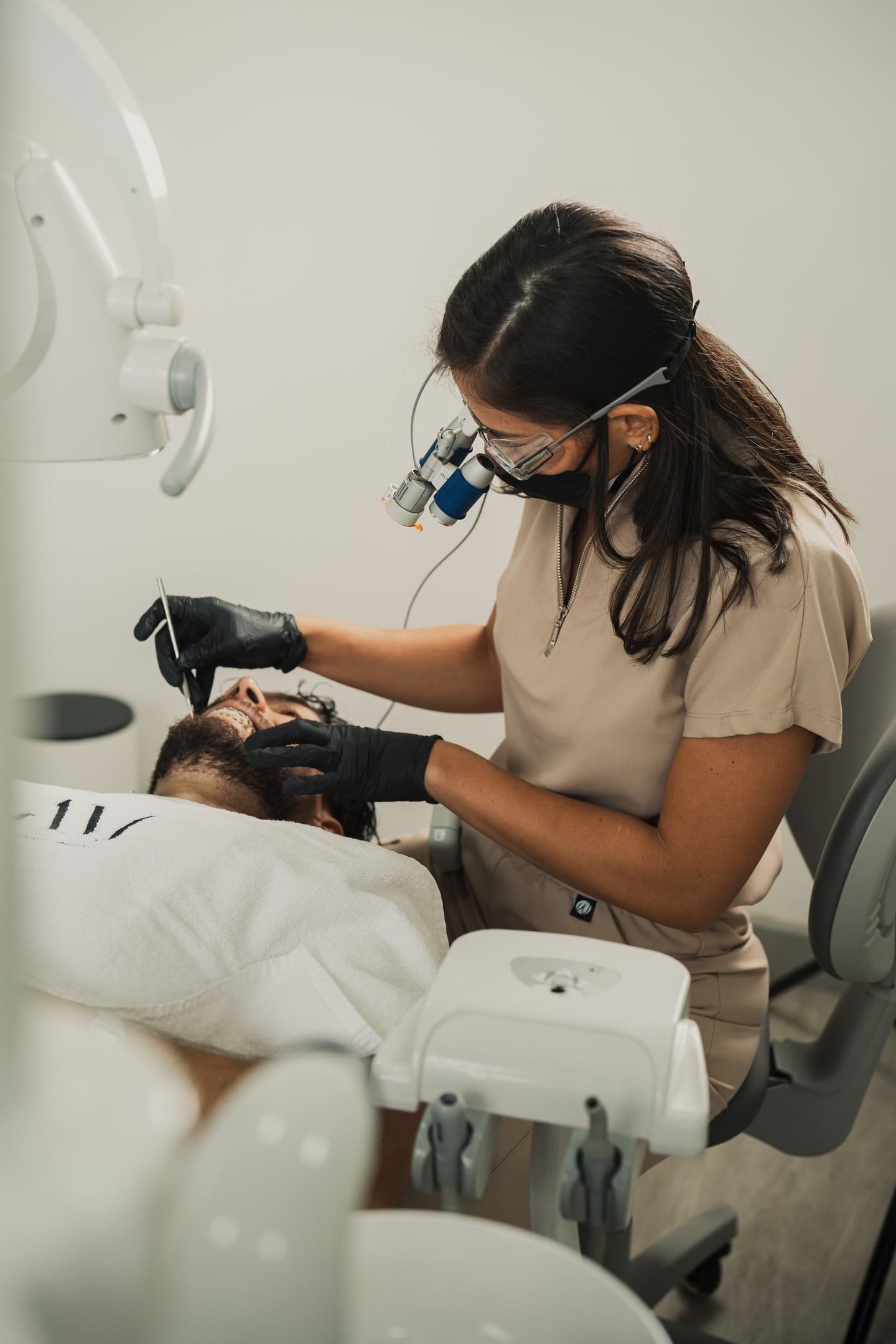
The first step isn't cosmetic, it's health. With a root canal we remove the necrotic tissue from inside the tooth, disinfect the canal, and seal it. That stops the infection and protects the bone. Also, by removing the source of the pigmentation, it opens the door to restoring the color.
The second step is internal whitening. Unlike regular whitening, which is applied on the outside, this one is placed inside the tooth, in the chamber where the nerve was, and is renewed over a few appointments until the color matches the neighboring teeth. As I always explain: the solution is usually to perform the root canal treatment and do internal whitening to restore the tooth's natural tone.
| Opción | Qué hace | Cuándo se usa |
|---|---|---|
| Endodontics | Elimina la infección y la fuente del color | Siempre que hay necrosis |
| Blanqueamiento interno | Aclara el diente desde adentro | Después de la endodoncia, si el diente está entero |
| Carilla | Cubre el frente con el color correcto | Si el blanqueamiento no alcanza o el color regresa |
| Crown | Cubre y protege todo el diente | Si además falta estructura |
What no one tells you: the color can come back
Here I want to be honest, because it's part of how we work. Internal whitening works very well in most cases; a five-year follow-up reported success in about 8 out of 10 teeth. But, as I warn my patients, the tooth often tends to re-pigment over time, and repeating the internal whitening may be necessary. I'd rather you know that from the start than have it surprise you in two years.
When the color doesn't hold, a porcelain veneer is a stable way to match it with the rest of your smile.
The most common mistake: whitening it from the outside
A regular whitening, whether in-office or at-home, doesn't lighten a tooth that darkened from the inside. Worse yet: it lightens the other teeth and the dark one stands out more. First the inside has to be treated.
It's the mistake we see most. The person notices a gray tooth, thinks it's a stain, and buys a whitening toothpaste, strips, or gets an in-office whitening without a prior check-up. The result: the healthy teeth lighten and the dead tooth looks even darker by comparison.
It happens because the color of a necrotic tooth isn't on the surface; it's in the dentin, from the inside out. No product applied on the outside reaches there with enough strength. That's why, before any dental whitening, we need to know where each stain comes from. We explain it in dental stains: precise diagnosis and treatment plan.
If your tooth changed color, do this
- Don't whiten it on your own.
- Remember if there was an impact, even if it was years ago: it's a key piece of information for the diagnosis.
- Check the gum around it: look for little bumps, inflammation, or pain when pressing.
- Schedule an evaluation with an X-ray.
- If you had an impact recently, don't wait for it to change color: ask for the check-up now. And if the tooth broke or moved, follow the steps in what to do if your tooth breaks or falls out.
Do you have a tooth darker than the others, or did you have an impact recently? Schedule an evaluation. We check whether the nerve is alive and explain, straight up, how to save it and restore its color.
Frequently Asked Questions
¿Por qué se pone gris un diente después de un golpe?
Porque el golpe dañó los vasos y el nervio del diente. El tejido interno muere y, con el tiempo, lo pigmenta desde adentro.
¿Un diente oscuro siempre está muerto?
No siempre, pero el color gris es la señal más común de necrosis del nervio. Se confirma con pruebas de vitalidad y radiografía.
¿Se puede blanquear un diente oscuro?
Sí, con blanqueamiento interno después de una endodoncia. El blanqueamiento normal por fuera no funciona en estos dientes.
¿Es grave si no me duele?
Sí puede serlo. Un nervio muerto no duele, pero la infección puede avanzar al hueso en silencio y llevar a la pérdida del diente.
¿El diente puede volver a oscurecerse?
Sí. Con el tiempo puede volver a pigmentarse y necesitar un nuevo blanqueamiento interno, o una carilla si el color no se mantiene.

Sources consulted
- World traumatic dental injury prevalence and incidence (Petti et al., 2018) — The Dental Elf
- Five-year follow-up of internal bleaching (Braz Dent J, 1999) — PubMed
- Diente oscuro: causas y tratamiento — Sanitas
This article is for informational purposes and does not replace a personalized clinical evaluation.