You were eating a toast, a bolillo roll, or some popcorn, and suddenly: crack. You feel a little loose piece in your mouth and think "what bad luck, it was too hard." I have uncomfortable news for you: a broken tooth is almost never bad luck. The bread was just the last straw.
A healthy tooth is designed to withstand enormous forces for a lifetime. When it breaks on something ordinary, it's because something had been weakening it beforehand: clenching your teeth at night, an old large filling, a bite that puts extra load on a single point, or enamel that was weakening without you realizing it.
And cracks are much more common than you think. A registry of dental clinics in the United States found that more than two-thirds of patients have at least one cracked tooth, and that painful cracks are mainly associated with clenching or grinding your teeth. The question isn't whether it broke. It's why it broke.
In this article
Why does a tooth break without a strong impact?
Because it was weakened. The most common causes are bruxism (clenching or grinding), large or old restorations, root canal-treated teeth without protection, an unbalanced bite, and weakened enamel. The impact or the hard food just finishes the job.
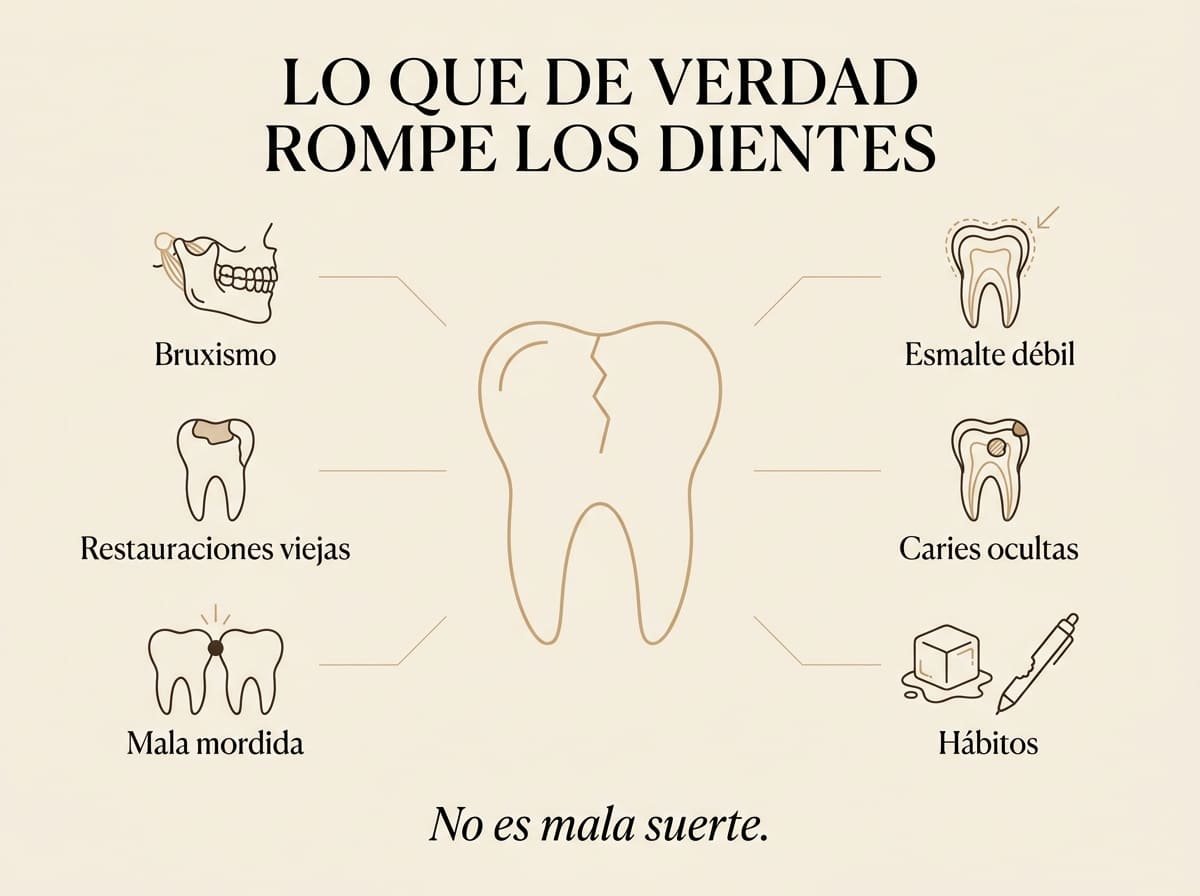
We explained this recently on our Instagram and I'll repeat it here: it's not always from an impact. It can be wear, decalcification, or a bad bite. A tooth is like a glass that gets tapped a little every day: nothing happens, nothing happens… until one day it breaks on something that seemed harmless.
| Causa | Cómo debilita el diente | Qué tan común es |
|---|---|---|
| Bruxismo (apretar o rechinar) | Fuerzas muy superiores a las normales, a veces cada noche | Muy común |
| Restauraciones grandes o antiguas | El diente queda como un cascarón; las paredes se debilitan | Muy común |
| Diente con endodoncia sin corona | Pierde estructura y se vuelve más frágil | Común |
| Mordida desbalanceada | Un solo diente recibe más carga de la que le toca | Común |
| Esmalte debilitado | Ácidos, reflujo o descalcificación adelgazan el esmalte | Común |
| Caries ocultas | Ahuecan el diente por dentro sin que se vea por fuera | Común |
| Hábitos | Masticar hielo, plumas o uñas, abrir bolsas o botellas con los dientes | Evitable |
The first one on the list deserves special attention. Many people clench their teeth without knowing it, especially at night or when they're focused or stressed. If it's never been checked, start with our guide on bruxism and how to stop it.
Restorations count too. An amalgam or a very large filling that has been in the mouth for 15 or 20 years leaves thin walls that flex a little with every bite. After years, one gives way. That's why restorations have a lifespan and it's worth reviewing them.
The most treacherous thing is that many of these cracks warn before breaking. The problem is that almost no one knows how to recognize those warnings.
The signs that a tooth is cracking
Sharp pain when biting something or when releasing the bite, cold sensitivity that comes and goes, and a pain you can't pinpoint to a specific tooth. If you notice it, see a dentist before the crack progresses.
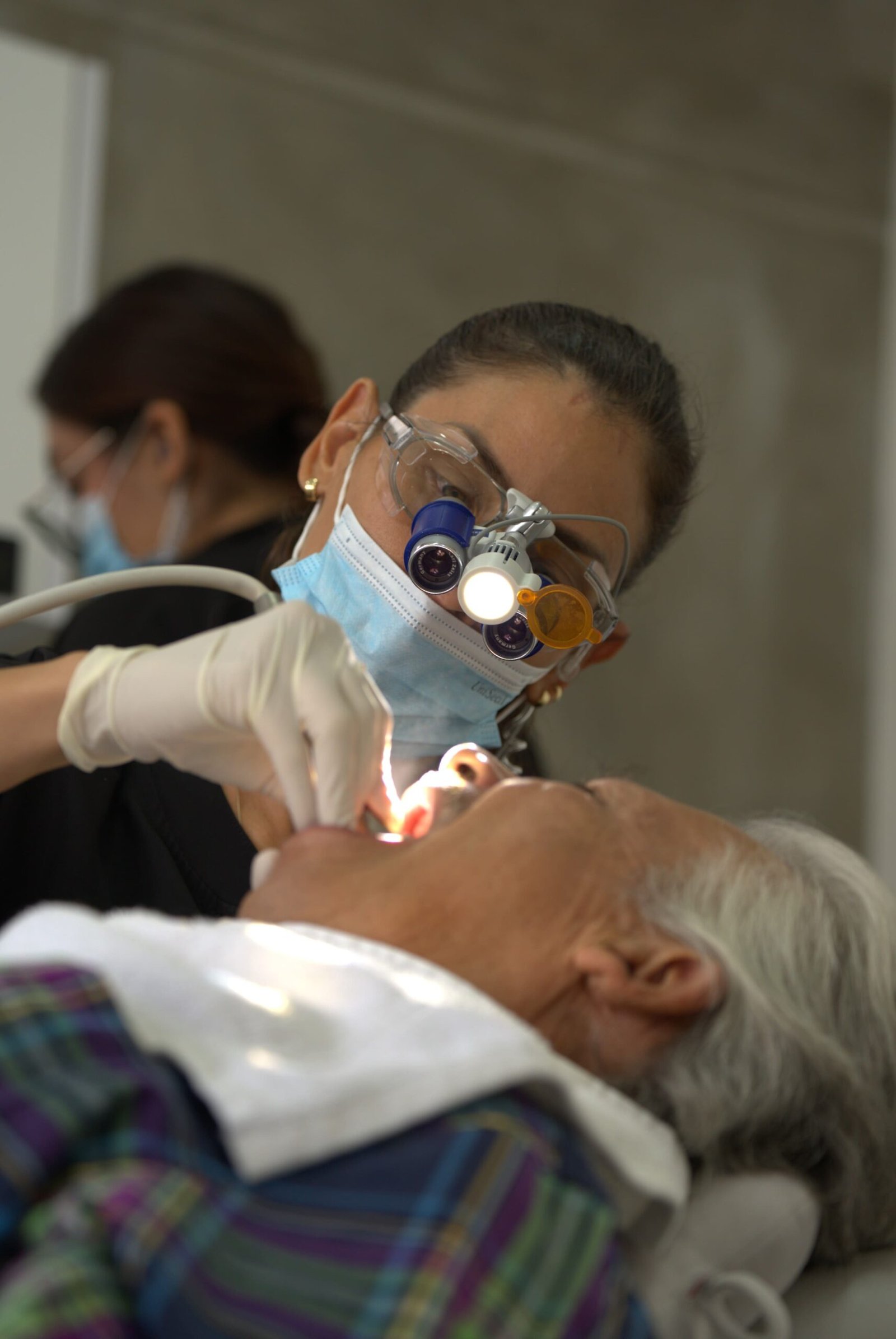
A crack doesn't always hurt all the time. What's typical is a sharp, quick pain at a specific moment: when you bite something and, above all, when you release the bite. It's the crack opening and closing. Many patients describe it as "a little zap" that appears and disappears for weeks.
- Sharp pain when biting something specific, or when releasing.
- Cold sensitivity that isn't constant.
- You don't know exactly which tooth it is: "it's around here, in the lower molars."
- You avoid chewing on one side without realizing it.
- You see a line on the tooth or feel a rough edge with your tongue.
- Visible wear: flat teeth, chipped edges, or notches near the gum.
How to tell it apart from a cavity? Cavity sensitivity usually appears with sweets and lingers for a while; the sensitivity from a crack is more of a brief sharp twinge when biting at an exact point. When in doubt, the best thing is to get it checked.
An important detail: many cracks don't show up on an X-ray. That's why in the office we use other methods: bite tests on specific cusps, light to transilluminate the tooth, staining, and, when needed, magnification. It's not rare for a patient to arrive after being told "nothing shows up on the X-ray."
And when the tooth has already broken, the first thing is to know what type of fracture it is, because everything else depends on that.
Crack, broken cusp, or split tooth: not the same thing
There are superficial cracks that don't need treatment, broken cusps that repair well, cracked teeth that need to be protected soon, and fractures that reach the root and usually end in extraction. The earlier it's treated, the more options there are.
Not all cracks are the same, and it's important to know this so you don't get overly alarmed or overly complacent. This is the classification we dentists use, explained simply:
| Tipo | Qué es | Tratamiento habitual | Pronóstico |
|---|---|---|---|
| Líneas superficiales | Grietas finas solo en el esmalte | Vigilar; no suelen necesitar tratamiento | Muy bueno |
| Cúspide fracturada | Se rompió una «puntita» de la muela | Restauración, incrustación o corona | Bueno |
| Diente fisurado | Grieta que avanza de arriba hacia la raíz | Corona pronto; a veces endodoncia | Depende de qué tan profunda sea |
| Diente partido | La grieta separó el diente en dos | A veces se conserva una parte; muchas veces, extracción | Reservado |
| Fractura vertical de raíz | Grieta en la raíz, frecuente en dientes con endodoncia | Generalmente extracción | Malo |
Superficial lines, by the way, are very common in adults and are almost never a cause for alarm. What matters is distinguishing them from a crack that's progressing.
Notice how the prognosis worsens as the crack goes deeper. That's why I insist so much on not waiting. A broken cusp today is fixed with a restoration; that same crack in six months can reach the root.
Teeth with root canals deserve a separate mention. By losing their nerve and part of their structure, they're left more fragile. Many of them need a crown so they don't split, something we explain in why sometimes the tooth needs more crown to be saved.
Now comes the part almost no one does, and it's the reason so many people break the same tooth, or the one next to it, over and over again.
Fixing without knowing the cause is paying twice
If only the broken tooth is repaired and what broke it isn't corrected, the fracture comes back, in that tooth or another. Before restoring, the cause must be identified: bruxism, bite, habits, or weakened enamel.
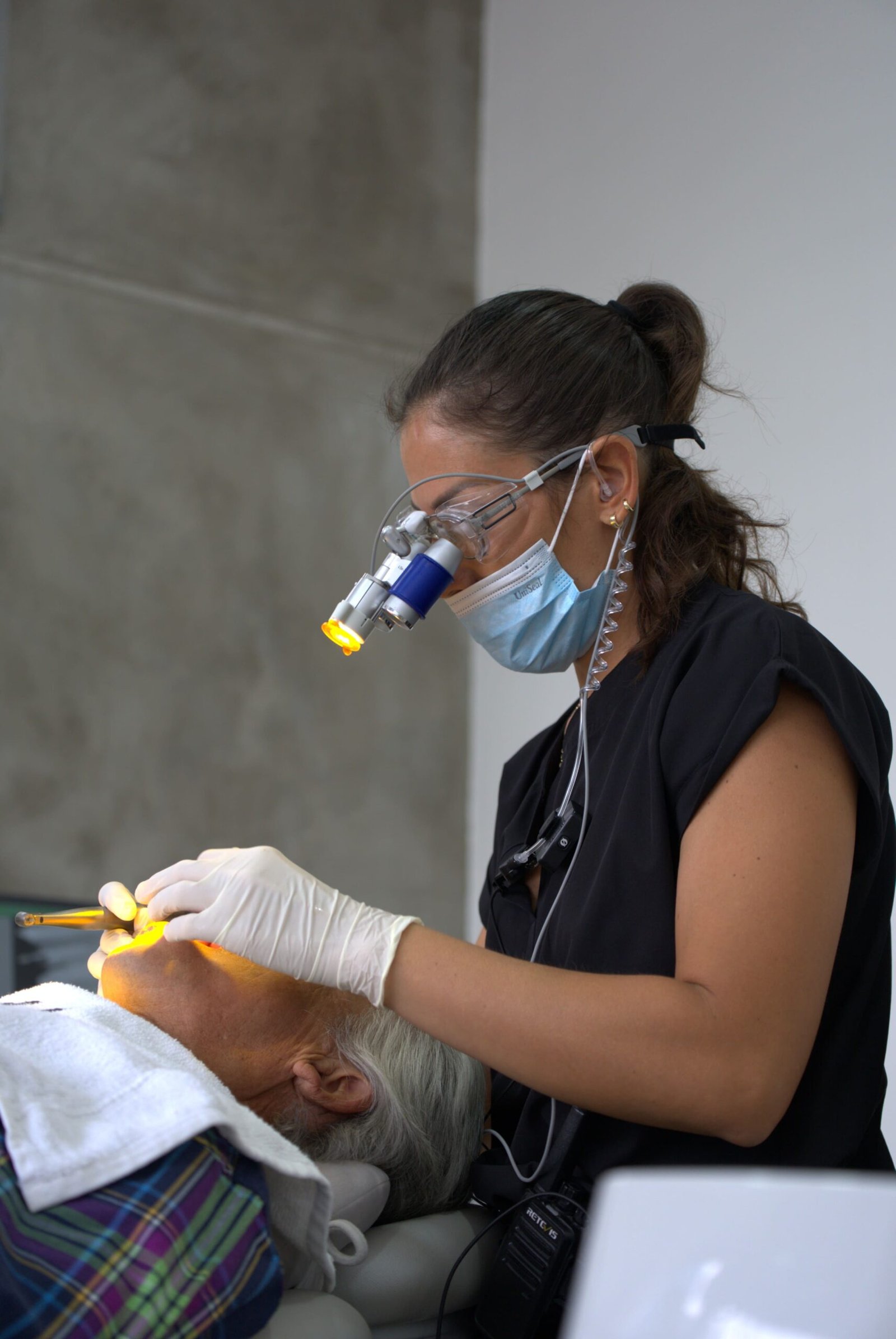
This is, for me, the most important part of the article. As I say in the office: the most important thing is to know what's causing those fractures or what's provoking them, so that when we restore the teeth we prevent new fractures.
Think of it this way: if a tooth broke because you clench at night, and all we do is put in a new filling, what's going to happen? You're going to keep clenching. And that filling, or the one on the tooth next to it, is going to receive the same force that broke the first one. It's fixing the leak without changing the pipe.
What we check before repairing
- Wear pattern: flat teeth, shiny facets, or chipped edges give away bruxism.
- Bite: if one tooth touches before the others or receives more load. We explain it in what a healthy bite is.
- Old restorations: which ones have thin walls and should be protected before they break.
- Enamel: if there's erosion from acids, reflux, or diet. Here it helps a lot to strengthen enamel with diet and habits.
- Habits: ice, nails, pens, opening things with your teeth.
With that we build a plan that doesn't just repair, but protects. Sometimes it includes a custom-made night occlusal guard, which absorbs the force of bruxism. Note: not just any guard works, and a poorly made one can make the problem worse, as we explain in unregulated night guards.
What to do if your tooth breaks today
Save the fragment if you find it, rinse with warm water, avoid chewing on that side, and schedule a check-up in the coming days. If there's severe pain, bleeding that won't stop, or swelling, it's an emergency.
Don't panic. Most fractures aren't an emergency the same night, but it's not a good idea to leave them for weeks either. These are the steps:
- Save the fragment in a container with milk or your own saliva. Sometimes it can be reattached.
- Rinse with warm water to clean the area.
- Protect the sharp edge with orthodontic wax or sugar-free gum if it's hurting your tongue.
- Don't chew on that side and avoid very cold, very hot, or very hard foods.
- Schedule a check-up as soon as possible, even if it doesn't hurt.
If a whole tooth was knocked out by an impact, time matters much more. We explain it step by step in what to do if your tooth breaks or falls out.
So it doesn't happen to you again
- If you suspect you clench your teeth, ask to have your wear checked.
- Don't use your teeth as tools.
- Swap the ice habit for cold water.
- Have your old restorations checked, especially the large ones.
- Protect root canal-treated teeth as your dentist indicates.
Your tooth broke and it wasn't bad luck. It was a warning. Do your teeth break often, or do you feel that "zap" when biting? Schedule an evaluation: we find the cause and propose how to prevent the next fracture.
Frequently Asked Questions
¿Por qué se me rompió un diente si no me golpeé?
Porque ya estaba debilitado por bruxismo, una restauración grande, una mala mordida o esmalte desgastado. La comida dura solo terminó de romperlo.
¿Un diente agrietado se ve en la radiografía?
Muchas veces no. Se detecta con pruebas de mordida, luz, tinciones y magnificación en consulta.
¿Se puede salvar un diente fracturado?
Depende de la profundidad. Una cúspide rota se repara bien; si la fractura llega a la raíz, suele ser necesaria la extracción.
¿Qué hago si se me rompe un diente?
Guarda el fragmento en leche, enjuágate con agua tibia, evita masticar de ese lado y agenda una revisión lo antes posible.
¿Cómo evito que se me rompan los dientes?
Identificando la causa: tratar el bruxismo, revisar la mordida y las restauraciones antiguas y no usar los dientes como herramienta.

Sources consulted
- Cracked Tooth Syndrome: Data Brief 4 — National Dental Practice-Based Research Network
- Carrusel "¿Tus dientes se fracturan con facilidad?" — Instagram de AM Dental Studio
This article is for informational purposes and does not replace a personalized clinical evaluation.