
You already went to the general practitioner. You already saw the ENT. They checked your ear, you had hearing tests, maybe even an MRI. And the result was the same: "you have nothing."
But it hurts. It hurts every day, and you've started to doubt yourself.
Quick answer: your pain is real. What happens is that it probably doesn't come from your ear, but from the joint that's millimeters away—the temporomandibular joint (TMJ). When that joint and the muscles surrounding it are overloaded, the pain radiates to the ear, temple, and neck. The ENT did their job well: your ear is healthy. The problem is that no one has checked the neighboring structure, and that territory isn't the ENT's domain—it's the dentist's.
Let's explain what's happening and why you've been going in circles for months without an answer.
1. Your pain is real, even if the tests come back fine
The first thing, because it's what those who come to the office like this most need to hear: that the tests come back normal doesn't mean you're exaggerating.
It's one of the most frustrating situations in medicine: a persistent, real, localized pain, with all tests in order. Many patients arrive after months of bouncing between specialists, not only with pain but with the feeling that no one believes them.
Temporomandibular joint disorders affect a significant portion of the adult population—the most cited estimates range from 5% to 12%, with a clear higher prevalence in women—and they are among the conditions that take the longest to diagnose. Not because they're rare, but because the pain appears where the problem isn't.
And there's the key to this whole matter.
2. Why the ear hurts if the problem is in the jaw
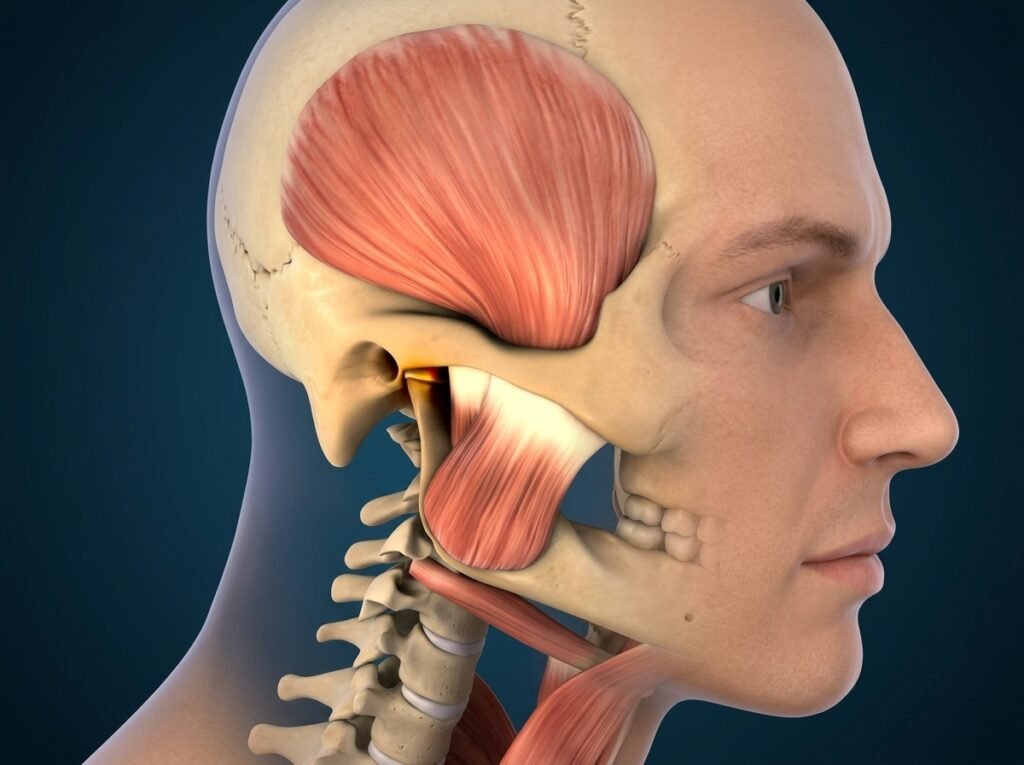
The explanation is simpler than it seems: it's a matter of centimeters and shared nerves.
The temporomandibular joint is literally right next to the ear canal. Put a finger just in front of your ear and open your mouth: what moves under your finger is the joint. It's millimeters from the ear. When this area becomes inflamed or the muscles that move it remain contracted for months, the brain has difficulty distinguishing the exact source of the pain and interprets it as ear pain.
Added to this is the sensation of a blocked ear, which also has an anatomical explanation. The muscles in the area share innervation with structures of the middle ear, so sustained muscle tension can produce a feeling of pressure, blockage, and even ringing—all with a perfectly healthy ear.
That's why the ENT finds nothing. Because, technically, there's nothing to find in the ear. The problem is next to it.
3. The pilgrimage: GP, ENT, neurologist… and no one checked your bite
If you identify with the following story, it's no coincidence: it's the typical journey of this condition.
It starts with the general practitioner, who sees a healthy ear and prescribes drops or anti-inflammatories. Since it doesn't improve, they refer to an ENT, who confirms the ear is fine. The ENT, if they suspect, may refer to a maxillofacial specialist; if not, it's common to be referred to a neurologist for possible migraine or neuralgia, or to an orthopedist for possible arthritis. Along the way there may be X-rays, MRIs, and several months.
Each specialist correctly rules out what's in their field. And yet, in many cases, no one asks the most basic question: how do your teeth fit together when you close your mouth?
It's no one's negligence. It's just that occlusion—the way your teeth contact each other—is dental territory, and the patient with ear pain doesn't think to go to the dentist. It's the only specialist they weren't referred to.
4. The 7 signs that your problem is joint-related and not ear-related
This is the list we recommend you review calmly. If you identify with three or more, the likelihood that the origin is joint-related is high:
- You hear a clicking or "crackling" right in front of your ear when opening or closing your mouth.
- The pain worsens with chewing, yawning, or talking for a long time—that is, it has a mechanical component.
- You wake up with jaw stiffness or with a headache in your temples, worse in the morning than in the afternoon.
- You feel a blocked ear, but it doesn't clear when swallowing and there's no fever or discharge.
- The pain radiates to the temple, cheek, or down the neck, instead of being a fixed point.
- The muscles in your cheeks or temples hurt when you touch them, as if they were contracted.
- It is clearly predominant on one side, usually the side you chew more on.
An important nuance: this list is a guide, not a diagnosis. And if at any point fever, discharge, marked hearing loss, intense dizziness, or acute unrelenting pain appear, that does require immediate medical attention to rule out an infectious process before anything else.
5. What your bite has to do with all of this
Here we get to the point that almost no one has explained to you, and which is the reason this article is written by a dental clinic and not an ENT.
Your jaw doesn't work alone: it works against your teeth. Every time you close your mouth—and you do it hundreds of times a day, swallowing, speaking, chewing—the final position of your jaw is determined by how your teeth fit together. If your bite has points that hit before others, uneven contacts, or an unstable position, the joint and muscles have to constantly compensate for that misalignment.
That compensation, sustained over months or years, is what exhausts the system. The muscles remain in constant tension, the joint bears uneven loads, and pain appears. If you also clench or grind your teeth due to stress—the famous bruxism—the overload multiplies, because you add hours of nighttime pressure to a structure that was already compensating.
It's worth mentioning something we see in practice: poorly planned dental treatments can also alter the bite. A high restoration, a crown that wasn't well-adjusted, or an aesthetic design done without considering function can trigger exactly this condition. It's one of the reasons we insist so much that a poorly planned smile design has consequences that go far beyond aesthetics, and why tooth wear should be evaluated with judgment before touching a single tooth.
6. What actually works (and why surgery is almost never the first step)

Good news, and we want to be clear about this because it generates a lot of anxiety: the vast majority of these cases are resolved without surgery.
Even maxillofacial surgeons confirm this: TMJ surgery is the last option, not the first. Treatment always starts with conservative approaches, and in most cases, it stays there. These are the usual tools:
- Occlusal splint or mouthguard. A custom-made device used primarily at night. It prevents direct contact between teeth, relieves the joint, and protects enamel from bruxism. It's usually the first step and often the most effective.
- Bite adjustment. Correcting the contact points that are causing the interference, with selective adjustments when the case allows.
- Orthodontics, when the underlying misalignment is what's generating the instability. Correcting the position of the teeth corrects the position of the jaw.
- Orofacial physiotherapy and exercises, to deactivate accumulated muscle tension.
- Stress management and habits, because the emotional tension component is real and determining in bruxism.
The important thing is to understand the logic: first, unload and stabilize, then correct the cause. Painkillers relieve, but they don't resolve—and living on them for months isn't a treatment.
7. What to expect from a bite evaluation
If you've made it this far recognizing yourself in several points, the next step isn't intimidating. An occlusal evaluation is a simple, non-invasive procedure.
What we do is check how your teeth contact when closing, palpate the joint and muscles to identify points of pain and tension, evaluate your opening and joint noises, and look for signs of wear that indicate bruxism. With that, we determine whether the origin is muscular, joint, occlusal, or a combination—which is the most common—and we plan the treatment starting from the most conservative approach.
None of this hurts, doesn't require invasive studies, and in a single appointment you can leave with something you've been looking for for months: an explanation.
If you also want to make sure you choose well who treats you for something as delicate as chronic pain, here we share clear signs for recognizing a trustworthy dentist.
Your pain has a name and it has a treatment. You were just knocking on the wrong door.
Note: this article is for informational purposes and does not replace a professional evaluation. If your pain is accompanied by fever, discharge, hearing loss, intense dizziness, or acute unrelenting pain, seek immediate medical evaluation.