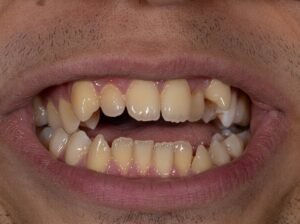
"Doctor, I want it to be noticeable that I got the change done."
We hear that phrase more and more often in practice. And each time we have to give an answer that, we know, isn't what the patient expected to hear.
Quick answer: patients who ask for their smile design to be noticeable are usually responding to a trend, social media aesthetics, and certain current stereotypes, not to what truly constitutes good work. A well-done smile design should look so natural that it completely blends in—perfect, without it being noticeable that there's a design behind it.
Yes, you read that right: the goal is not for it to be noticeable. It's exactly the opposite. And it's worth understanding why.
1. The phrase we hear more and more often in practice
It's not an isolated case. It's a pattern that repeats more and more frequently: patients who arrive with a photo of a celebrity or influencer, and instead of asking "I want to look natural, as if I'd always had this smile," they explicitly ask for the opposite—they want the change to be evident, almost like a badge.
It's an honest and understandable request. No one arrives asking for something "bad" on purpose. But behind that request there's a very specific confusion about what a successful smile design actually is—and clarifying it is, literally, our job.
2. Where this trend comes from: social media and the "celebrity smile" standard

This didn't come out of nowhere. In recent years, a very particular and recognizable aesthetic has become established: extremely white teeth, perfectly even, almost uniform with each other—the look that's popularly known as "Turkey teeth" or "influencer smile." It's a style that first went viral for its striking effect, and then for the backlash: more and more people point out on social media when someone "went overboard" with their design.
Patients who ask for their smile design to be noticeable are patients who are swayed by the social media trend and current aesthetic stereotypes. And it's understandable: if your entire feed is filled with that same smile, it starts to feel like the standard to follow, not an aesthetic exception.
The problem is that this standard wasn't born from serious cosmetic dentistry—it was born from a visual effect that works well in a profile photo, but in real life, when speaking, laughing, and aging, it looks exactly like what it is: dental work, not a smile. You can see concrete examples of this phenomenon in our analysis of which tooth shape suits you best and why the "catalog teeth effect" is exactly what we're describing here.
3. Why asking for it to "be noticeable" contradicts what a good design really is

Here's the point that's hardest for us to explain, because it goes directly against what the patient thinks they want.
A smile design shouldn't look noticeable. It should blend in completely, and look perfect without it being obvious that you have a design on top.
Think of it this way: when someone tells you "you have a beautiful smile," it's almost never because they noticed you had veneers. It's because the smile integrated so well with your face, your age, your skin tone, and your lips, that it simply looks like your smile—enhanced, yes, but yours. The moment someone can point out "those are designed teeth," the work ceased to be successful from a technical standpoint, even if the patient likes the result in the mirror on the first day.
This is the real difference between dental aesthetics done with sound judgment and dental aesthetics done for immediate impact in a photo.
4. The paradox: the more noticeable it is, the less perfectly it was actually done
Here's something counterintuitive worth repeating: the more "perfect" and striking the teeth look, the higher the probability that technically the work is poorly proportioned.
Extremely white teeth, exactly the same size as each other, with perfectly straight edges, don't exist that way in nature—not even in the most enviable smiles in the world. The natural dentition has slight asymmetries, subtle variations in tone, edges with micro-irregularities. When a design completely eliminates those variations "because it looks more perfect," it's actually eliminating exactly what makes a smile look believable.
It's the same logic we already explained when we talked about the physical signs of a failed smile design, like the "horse teeth" effect: excess is not synonymous with a better result. It's almost always synonymous with planning that prioritized immediate visual impact over true naturalness.
5. What happens when the dentist just complies instead of advising
Here's a responsibility we also have to assume as professionals: it's much easier to say yes to a patient who insists on "making it noticeable" than to have the uncomfortable conversation of explaining why that's not in their best interest in the long term.
When a dentist simply executes what the patient asks for—without advising, without explaining the why—the result almost always ends up following the same pattern: very high initial satisfaction, followed by a progressive erosion of that satisfaction over time, as the patient begins to notice that their smile "looks like someone else's" or that they no longer feel comfortable showing it in certain contexts. This spiral is, in fact, one of the most common paths to what we've already documented in dental dysmorphia and the dissatisfied smile syndrome: the feeling of never being entirely satisfied, even after having invested in the treatment.
That's why part of our job—and what we understand as real honesty with the patient—is to have this conversation before starting any treatment, not after.
6. How to know if your design is going to "be noticeable" before you decide
If you're about to decide on a smile design, there are concrete signs you can ask to have reviewed before committing to a treatment:
- Ask to see a simulation or mock-up before the final result—if it already looks "artificial" or disproportionate in the simulation, the real result will look equally or more pronounced.
- Ask if the chosen white shade was compared to the natural color of the sclera of your eyes and your skin—a white that doesn't relate to your natural tone is the first sign that the result will be noticeable.
- Ask explicitly if there will be natural variation between teeth, or if they will all end up looking exactly the same as each other.
- Be wary of any offer that promises "the perfect smile" in a standard mold, without an individual facial analysis in between.
If your current dentist can't answer these questions clearly, it's worth getting a second opinion. Here we share more clear signs for choosing your dentist with confidence.
Frequently Asked Questions
Why doesn't my dentist want my design to be noticeable? Because a successful smile design integrates completely with your face. If it's noticeable, it generally means the proportions aren't appropriate.
Do very white and even teeth look better? Not necessarily. The natural dentition has slight variations; eliminating them entirely usually looks artificial, not perfect.
What is the "Turkey teeth" effect? It's the popular name for excessively white and uniform smile designs, associated with viral backlash on social media due to their artificial appearance.
How do I keep my smile design from being noticeable? Ask for an individual facial analysis, a prior simulation, and a white shade that matches your skin and eyes, avoiding standard "perfect smile" molds.