
If you just left your appointment and are wondering, "Why do my teeth hurt after my cleaning if I was fine before?", don't panic. It's not that the dentist did something wrong; in fact, it's quite the opposite.
Quick Answer: Tooth sensitivity after a cleaning is a normal response that usually lasts from 2 to 4 days. The pain occurs because we have removed the "tartar armor" that was covering your teeth, leaving the dentin (the inner layer) exposed to temperature changes. It is not enamel damage; it is your mouth regaining its ability to feel and breathe after eliminating an infection.
The myth of "aggressive cleaning": Why it didn't hurt before and why it does now
It is the number one complaint at clinics in Guadalajara: "Doctor, I came in without pain and now I can't even drink cold water." To understand this, Dr. Alejandra Mora from AM Dental Studio often uses an analogy that explains it perfectly: The jacket analogy.
The "Tartar Armor"
Imagine that for months or years you have been wearing a very thick thermal jacket (the tartar). Your body gets used to that heat. Suddenly, we take the jacket off in the middle of a Guadalajara winter. You are going to feel cold immediately. Tartar acts as a dirty thermal insulator. By accumulating around the tooth, it blocks external sensations, but at the same time, it is silently destroying the bone and gums. Upon removing it, the tooth is left "naked" to thermal stimuli for the first time in a long while.
Tartar "tricks" your nerves
When tartar is present, your nerves are somewhat "numbed" by the presence of bacteria. A dirty tooth is not a healthy tooth; it is simply a tooth that has lost sensitivity due to chronic inflammation. By deep cleaning, we are "waking up" the nerve, which is an excellent sign that your tissues are still alive and functional.
What is actually happening to your teeth during a cleaning at AM Dental Studio?
At our clinic in Guadalajara, we do not use rudimentary techniques. Modern dentistry has evolved to make this process as comfortable as possible.
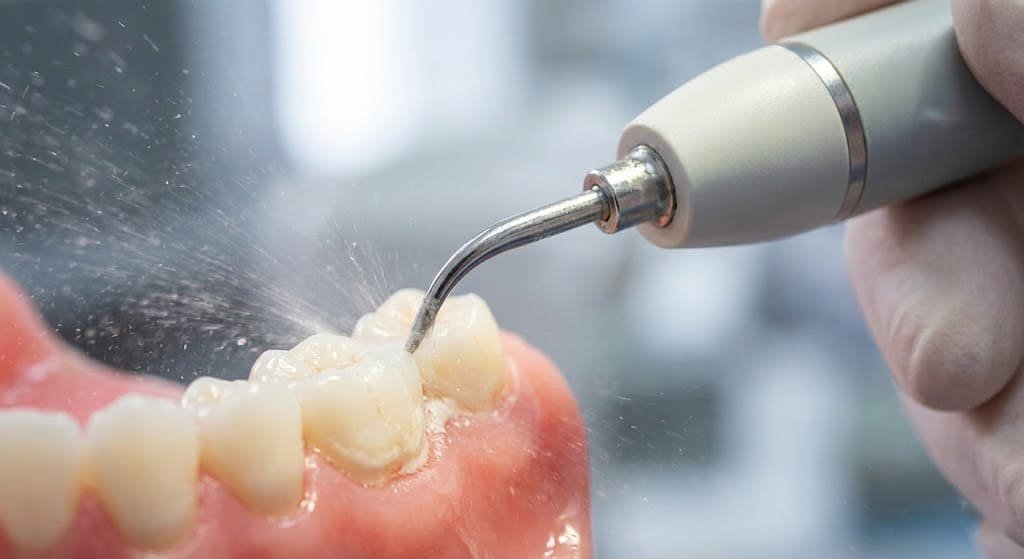
- Ultrasonic Technology (Piezoelectric): We use high-frequency vibrations to detach tartar without the need to aggressively "scrape" the enamel. This technology is gentle on your teeth but relentless with bacteria.
- Subgingival Removal: We clean what you cannot see. The pain usually comes from the areas beneath the gumline that were colonized by hard tartar.
- Precision Polishing: We eliminate coffee, tea, or tobacco stains, restoring the original smoothness to your enamel.
If you want to learn more about how we keep your smile flawless, check out our section on the importance of professional cleaning on our blog.
3 Scientific reasons why you feel post-cleaning sensitivity

If you are someone who needs the technical explanation, here is the breakdown of why your mouth is reacting this way:
1. Exposure of Dentinal Tubules
The tooth has thousands of microscopic channels called dentinal tubules that connect the exterior to the nerve. Tartar often plugs these pores with debris. Upon cleaning, the tubules are left open and the fluid inside them moves with cold or heat, sending an "alert" signal to the brain in the form of a twinge.
2. Residual Gingival Inflammation
If you had a lot of tartar, your gums were infected (Gingivitis). By removing the cause of the infection, the body sends blood to the area to repair the tissue. That temporary inflammation can slightly press against the tooth, causing a sensation of discomfort when chewing or to the touch.
3. Nerve Reactivation
After months of being insulated by a layer of bacteria, the dental nerve experiences a "hypersensitivity" phase while it recalibrates to its new clean environment. It is like when your eyes are dazzled when leaving a dark room; your teeth are being dazzled by the cleanliness.
How to relieve pain after your cleaning (Tips from Dr. Alejandra Mora)
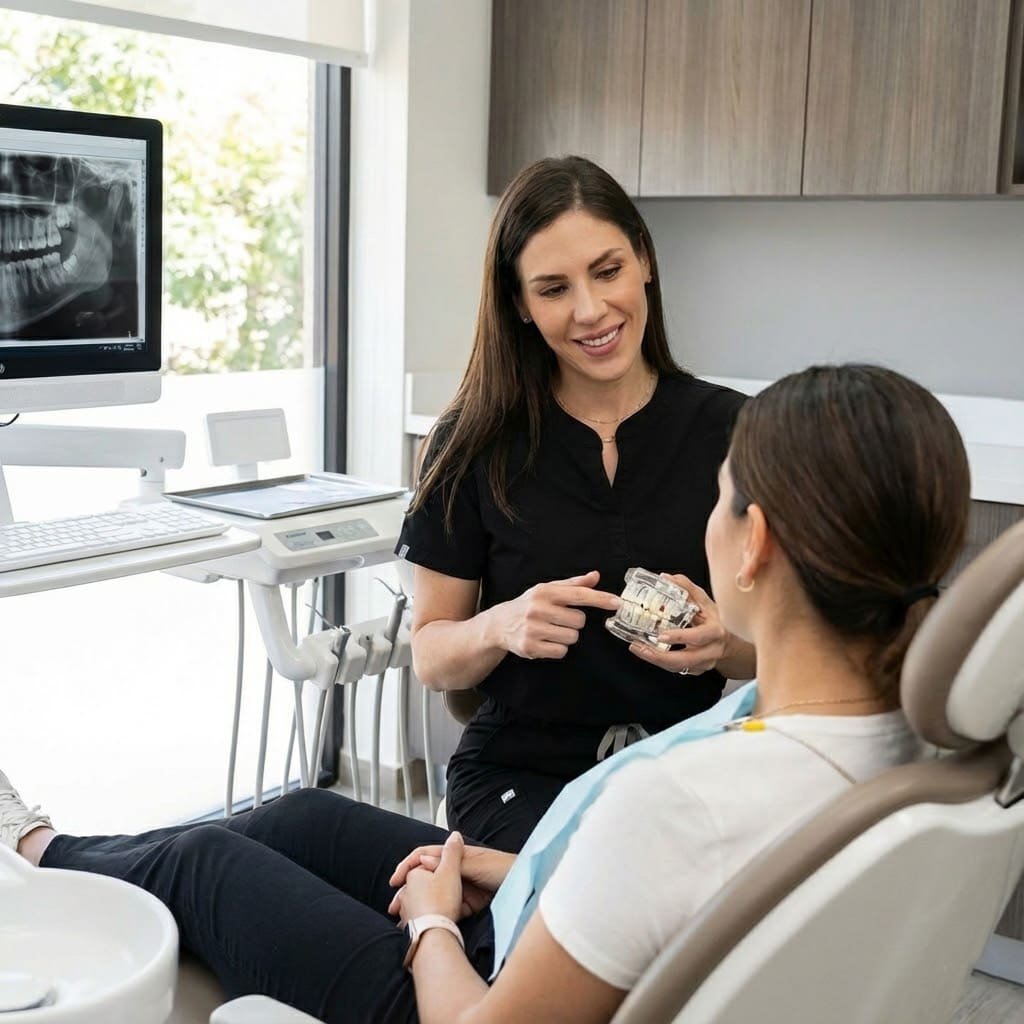
You don't have to suffer while your teeth adapt. Here is the post-appointment care guide we recommend at AM Dental Studio:
- Use desensitizing toothpaste: Look for toothpastes containing potassium nitrate. These help "seal" the dentinal tubules we mentioned earlier.
- Watch out for the Guadalajara weather: If you are leaving the clinic and there is a cool breeze, or if you are going for a very cold tejuino, be careful! Avoid extreme temperatures for at least 48 hours.
- "Soft" brushing technique: Do not use force. Use a soft-bristled toothbrush and circular movements. Less force means more health.
- Warm water and salt rinses: If your gums feel sensitive, this will help reduce inflammation naturally and quickly.
If the pain persists longer than expected, do not hesitate to schedule an evaluation with us in Guadalajara. We are here to ensure your recovery is perfect.
When should I be worried? (Red Flags)
Although sensitivity is normal, there are cases where we should take a second look:
- Pulsating and unbearable pain: If the pain does not let you sleep or does not subside with common pain relievers.
- Increasing inflammation: If you notice a lump or the gum becomes very red and hot after the third day.
- Fever: Any sign of fever indicates that there could be a previous infection that requires antibiotics.
Personalized follow-up is our priority. You are not just another number; we are your dental health allies in GDL.
Conclusion: A small price for a lifetime smile
Feeling sensitivity after a cleaning is a reminder that you have made the right decision. It is preferable to have 3 days of discomfort from a cleaning than a lifetime of pain due to tooth loss from periodontal disease.
Remember: A tooth that feels nothing under a layer of tartar is a tooth in danger. A tooth that feels the cold after being cleaned is a tooth coming back to life.
Do you need a cleaning that truly cares for your teeth?
Don't let the fear of pain hold you back. We combine state-of-the-art technology with the human touch of Dr. Alejandra Mora.
✅ Click below and schedule your appointment via WhatsApp today!