It seems like your message got cut off. Could you please provide the full text you'd like me to translate?
At AM Dental Studio, Dr. Alejandra Mora sees it every week. A patient arrives convinced their hygiene is perfect, but with a toothbrush destroyed in two weeks and gums crying out for help. And then comes the hard part: explaining something that seems counterintuitive: the harder you brush, the more damage you do and the more exposed your teeth become. Today I'm going to tell you exactly what's happening in your mouth and how to stop it before the damage becomes irreversible.
"Brushing harder isn't better": Dr. Alejandra Mora makes it clear
The phrase that titles this section comes from the doctor herself. And she repeats it at AM Dental Studio with the same certainty with which she greets you when you walk into the office: "Brushing harder isn't better. What's best is using proper technique, a soft, controlled brush. By controlling your technique, we achieve much better results." This isn't a magazine tip. It's a clinical warning.
The "Scouring Pad" Myth in Your Mouth
As children, we were taught a dangerous association: "if it's stuck, scrub harder." But bacterial plaque isn't hardened tartar or burnt food. It's a biofilm that is disrupted gently, not with sandpaper pressure.
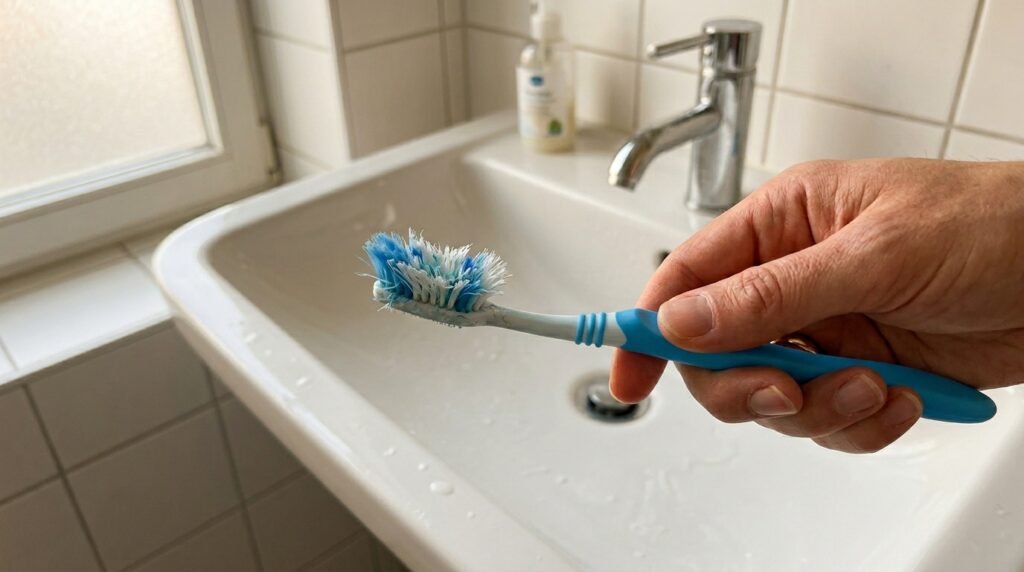
When you use too much force, the bristles splay out like spider legs and lose their sweeping ability. And worse: instead of cleaning, the bristles start eroding the neck of the tooth. Think of a wire brush going over the same spot every day. That's how you lose enamel.
"A soft, controlled brush is best": the technique that actually works
Dr. Mora insists: "Using a soft-bristled brush and controlling pressure are the keys to not damaging your gums." While force breaks things, technique builds them. The FDI World Dental Federation is clear: hard-bristled brushes, combined with high manual pressure, multiply the risk of cervical defects and gum recession.
If you open your bathroom cabinet right now and your brush says "medium" or "hard," throw it away. You only need "soft" or "ultrasoft." And if you already notice the bristles splaying after just two weeks of use, you have two problems: an unsuitable brush and excessive force.
Dental Abrasion: When the Toothbrush Turns into Sandpaper
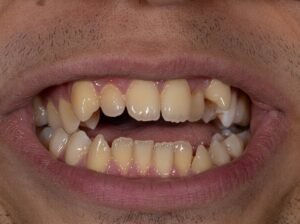
Dental abrasion is the real term for what's popularly known as "long teeth." The enamel wears away at the base of the tooth, and the gum, under attack, recedes to protect itself. The result is a smile where you see the roots and a feeling of "long teeth" that makes you look older.
"You're sanding down your tooth without realizing it": the lines at the neck of the tooth
That notch you see right where the gum meets the tooth isn't a crack. It's mechanical wear. It's caused by horizontal sawing motions applied with too much pressure. Dr. Mora sums it up with a very visual image: "It's like sanding down the neck of your tooth every morning. The enamel thins out, and the dentin—which is much softer—gets exposed."
When dentin is exposed, the tooth becomes hypersensitive. And the problem isn't just the pain. It's that this exposed dentin is much more vulnerable to cavities and the chemical wear from dietary acids.
Gum Recession: That "Increasingly Longer Tooth" in Your Mirror
Gum tissue is very delicate. It doesn't withstand constant trauma. When you brush it forcefully, the body's reaction is to recede—to abandon the area to get away from the aggressive stimulus. It literally pulls back.
Dr. Mora warns seriously: "Gum tissue that recedes doesn't come back on its own. We can do grafts in some cases, but the goal is to never have to go there." If you can already see the necks of your teeth when you smile, the sign is crystal clear. You need to stop brushing with fury right now and schedule an evaluation to assess the degree of recession.
The "Shock" from Drinking Something Cold: Dental Sensitivity as a Warning Signal
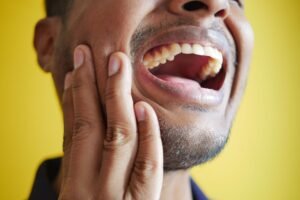
Dental sensitivity is the hallmark symptom of the patient who brushes hard. It's not normal for ice cream to make you jump out of your chair. Sensitivity is your tooth screaming at you: "The enamel is gone, the dentin is exposed, and the cold is hitting the nerve directly."
If you feel that sharp pain, the first step is to stop applying force. Second, change your toothbrush. Third, come in for a consultation. Dr. Mora emphasizes: "A lot of sensitivity disappears just by correcting your technique and stopping brushing like it's a saw."
"Never can the cleanings by specialists be replaced": the irreplaceable role of the dentist
There are those who, upon realizing all of this, swing to the opposite extreme: they buy a soft brush, start using exquisite technique, and decide they no longer need to go to the dentist. And that's another mistake.
Dr. Mora insists: "Never can the cleanings by specialists be replaced by just the patient's own cleaning. We can clean in depth—it's much better."
The Tartar Armor You Don't See
In the office, we use ultrasound and Air Flow with bicarbonate to remove the tartar that your brush can never remove. That tartar acts like a dirty armor that hides recessions and sensitivity. When we remove it, the tooth may be temporarily more sensitive, but it's the only way to truly clean the mouth. It's a complete professional dental cleaning.
Every 3, 4, or 6 months, depending on your habits
The doctor explains it without complexities: "That's why hygiene maintenance appointments can range from every three, four, or six months per year, depending on the patient's habits and whether their hygiene is good or bad." If you smoke, drink a lot of coffee, or your technique is inconsistent, your frequency is closer to every 3 or 4 months. If your hygiene is excellent and consistent, every 6 months may be enough. But never more than 6 months, because subgingival tartar starts silently eroding the bone.
Your Restart Plan for a Proper Brushing Technique
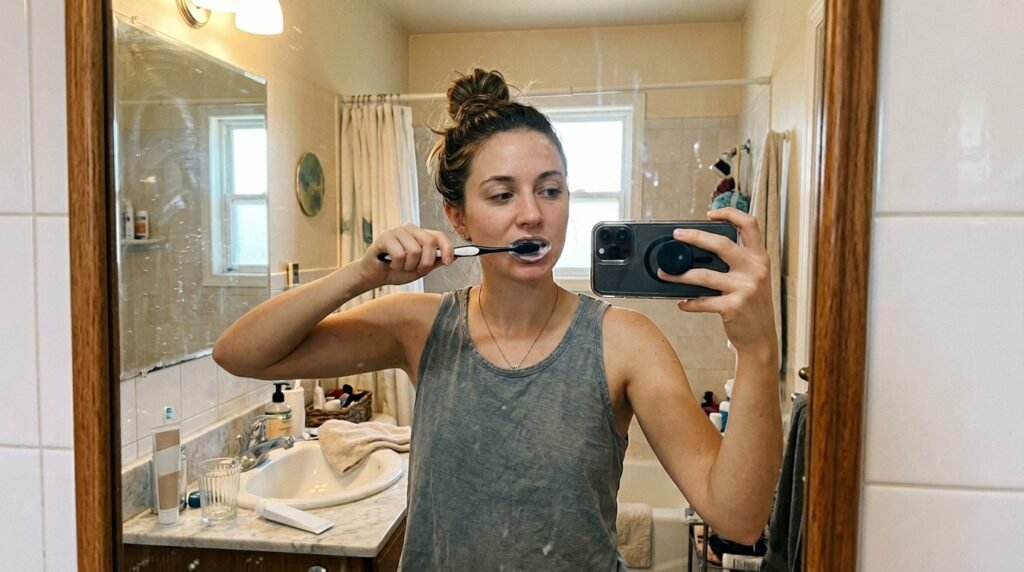
You already know what happens when you overdo it with force. Now take the solution in 3 steps.
The toothbrush: identify the change indicator
Buy a soft brush, small head, and firm handle. If your teeth have open gaps or severe crowding, a sonic electric toothbrush with a small head will help you reach better. Look at the bristle color indicator: when the blue turns white, it's time to change it. If it has no indicator, the rule is every 3 months or as soon as you see the bristles even slightly deformed.
The kitchen scale trick to avoid overdoing it
Proper brushing should not exceed 150-200 grams of pressure. Do this test at home:
- Place a digital kitchen scale on your bathroom counter.
- Rest the bristles on the surface and press as if you were brushing.
- If the display exceeds 200 grams, you're using too much force.
The right feeling is that of a massage, not a scrub. Hold the brush with two or three fingers, not with a closed fist. With an open hand, you can't exert as much force.
The Bass Technique in 3 Movements
Dr. Mora recommends the Bass technique. Pay attention:
- 45-degree angle toward the gum.
- Vibratory movements, not dragging motions.
- No rush: 2 seconds for every 2 or 3 teeth.
Vibrate, don't saw. That's the key. And if you want a visual guide to a technique that corrects bad practices, the AM Dental Studio blog has a complete explanation of how to brush without damaging your gums.
FAQs
1. Why do my teeth look longer?
Due to gum recession. It's almost always caused by aggressive brushing. The gum recedes and exposes the neck of the tooth, creating the visual effect of a long tooth.
2. How do I know if I'm brushing too hard?
If your toothbrush bristles splay in less than a month, you feel sharp pain from cold, or you see notches near the gum line, you're applying too much pressure.
3. Can gum recession be reversed?
Lost gum tissue does not come back on its own. It may require a gum graft. The key is to stop aggressive brushing to prevent losing more gum.
4. How often should I get a professional cleaning?
Depending on your hygiene level, every 3, 4, or 6 months. Dr. Mora recommends not exceeding 6 months to prevent tartar from damaging the bone.
5. Manual or electric toothbrush—which is better?
Both work if your technique is good and pressure is gentle. Manual is cheaper if you control your force. A quality electric toothbrush is an excellent complement.
¿Listo para decirle adiós a la sensibilidad?
Agenda una evaluación con la Dra. Alejandra Mora.
Revisaremos tus encías, tu técnica de cepillado y te daremos un plan claro para proteger tu sonrisa.
🕐 Respondemos en menos de 2 minutos
🔒 Consulta 100% confidencial y sin compromiso