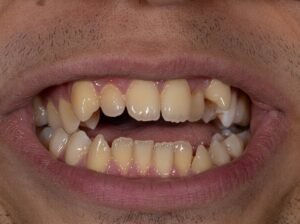
If you feel like your breath doesn’t improve even after brushing your teeth, you’re not the only one this happens to. In many cases, bad breath is indeed linked to poor oral hygiene: food debris, bacterial plaque, inflamed gums, or buildup on the tongue. However, there are also situations where brushing alone doesn’t solve the problem because the real cause lies elsewhere.
From Dr. Alejandra’s clinical perspective, there is a very common mistake: many people try to mask the odor with mouthwashes, gum, or mints, when what really matters is identifying where it comes from. That’s why, if bad breath is already a concern for you, the most helpful approach is not to hide it, but to understand what’s causing it and seek a professional evaluation if the problem persists.
Can poor brushing cause bad breath?

Yes, it definitely can cause it.
When teeth, gums, interdental spaces, and the tongue are not properly cleaned, food particles and bacteria build up. This accumulation promotes bad odor, especially when oral hygiene is incomplete or inconsistent.
Now, here’s an important point: it doesn’t always mean the person “doesn’t brush.” Sometimes brushing is done, but the routine is incomplete. For example:
- brushes too quickly
- doesn’t use dental floss
- doesn’t clean the tongue
- has tartar buildup
- has bleeding gums
- uses mouthwash to mask the odor
- or has hard-to-reach areas that aren’t properly cleaned
In other words, the problem may be a lack of brushing, but it can also be insufficient or poorly focused brushing.
Why does the mouth smell bad when hygiene is insufficient?
When food particles remain in the mouth, bacteria break them down. This promotes the development of bad odor, especially if there is also a coated tongue, inflamed gums, or buildup near the gumline.
Saliva also plays a role. When the mouth is dry, bad odor can become more intense. That’s why some people notice worse breath in the morning, after several hours without eating, when breathing through the mouth, or when they drink little water.
From clinical practice, this aligns with something Dr. Alejandra often observes: patients who believe that “brushing more often” is enough, when in reality the problem usually lies in how they are cleaning, which areas they are missing, and whether inflammation or tartar is already present.
Signs your bad breath *might* actually be from poor oral hygiene
1. The smell goes away for a bit after brushing, but comes back fast.
This usually means bacteria are constantly building up in spots you're not cleaning properly.
You’re not flossing every day.
A lot of the time, the smell doesn't come from the surface of the tooth itself, but from food trapped between teeth or near the gum line.
3. Your tongue looks white, yellowish, or coated
Your tongue can build up residue and bacteria that keep bad breath going even if you do brush your teeth.
4. Your gums are bleeding.
Bleeding shouldn't be considered normal. It can be a sign of gum inflammation, and in many cases bad breath accompanies this problem.
5. You notice tartar, plaque, or a bad taste in your mouth.
If you feel a constant sense of uncleanliness, a bad taste, or notice visible buildup, the problem probably can't be resolved by brushing at home alone.
In those cases, a \dental cleaning can help, but first it is advisable to check if that is actually enough or if something deeper is needed.
When bad breath isn't just due to a lack of brushing
This is where it pays to be very clear: not everything can be solved with a toothbrush and toothpaste.
If bad breath persists even though you are trying to improve your hygiene, it is worth considering other possibilities, such as:
- gum inflammation,
- tartar under the gumline,
- cavities,
- periodontal problems,
- dry mouth,
- mouth breathing,
- eating habits,
- salivary pH,
- gastric pH,
- or an incomplete hygiene routine.
That is precisely why, in many cases, it is not enough to say “brush better.” It is necessary to check what is actually happening.
If there is a suspicion of a deeper problem, it is helpful to read about the difference between scaling and dental cleaning, because not all cases of bad breath are resolved with a basic cleaning.
The most common mistake: covering up the odor instead of checking the cause
Este es uno de los errores más comunes.
The person buys a stronger mouthwash, chews gum, uses mints, or brushes many times a day. That may help for a few minutes, but it doesn't necessarily solve the problem.
From Dr. Alejandra's approach, when bad breath is constant, it is not advisable to focus only on hiding it. The important thing is to identify if there is a clinical cause behind it: plaque, tartar, a coated tongue, inflamed gums, or some other condition.
If you use mouthwashes, it is helpful to understand that they are a complement, not the main solution. Here you can support that point with this interlink: \types of mouthwash and oral rinses.
How to tell if you are brushing, but not cleaning well
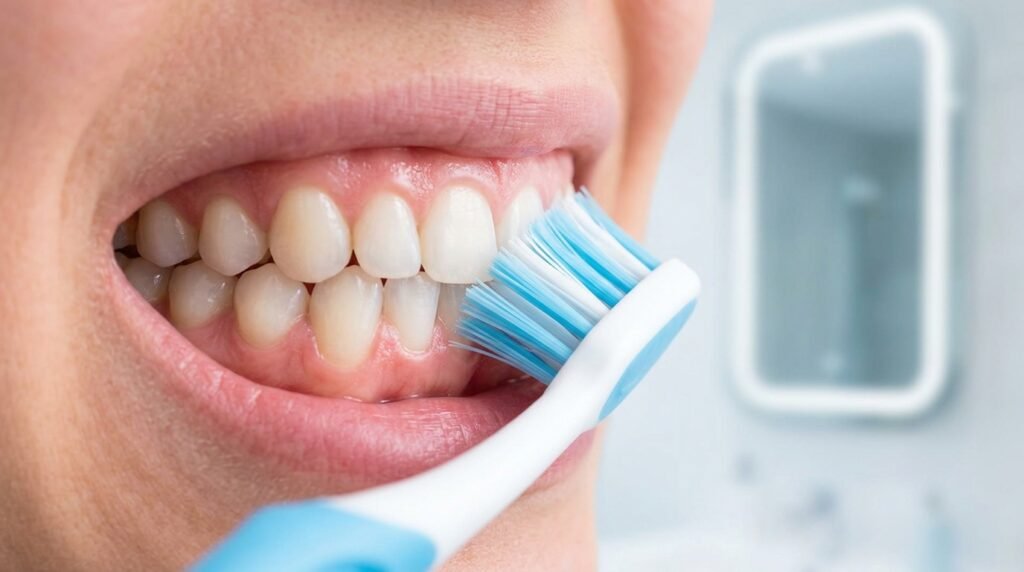
There are people who do have a daily routine and still have bad breath. This usually happens when:
- brushing lasts too short,
- the gumline is not cleaned,
- the tongue is not cleaned,
- floss is not used,
- an area is avoided because it bleeds,
- there are teeth with plaque retention,
- or there is accumulation that no longer comes off at home.
Here is an important idea: doing more doesn't always mean doing better. Many times, the change that improves breath the most isn't buying another product, but learning a more complete hygiene technique and correcting habits.
If the problem is accompanied by visible accumulation, it is best to assess whether you need a professional dental cleaning.
What you can do at home if you suspect that bad breath is related to hygiene
If the problem seems mild and recent, you can start with these measures:
Brush well, not just fast
It is not just about getting it done, but about carefully cleaning all areas.
Use dental floss
Especially if food tends to get trapped between teeth.
Clean your tongue
Many people improve significantly just by adding this step.
Drink enough water
Dry mouth can worsen the odor.
Do not rely only on mouthwash
It can help as support, but it does not replace good hygiene or a professional check-up.
Observe what makes it worse
Pungent foods, long periods without eating, low water consumption, or poor hygiene usually have a significant influence.
If you make these changes and the problem persists, it is no longer advisable to keep trying products without an examination.
When to schedule a dental assessment
It would be a good idea to schedule a check-up if you identify with any of these points:
- bad breath does not improve even if you brush,
- your gums bleed,
- you notice visible tartar,
- you have a constant bad taste,
- you feel that something is not right in your mouth,
- you use mouthwash all the time and the problem returns,
- or you are concerned that the odor persists even though you have hygiene habits.
In those cases, the most useful thing is a complete evaluation to check teeth, gums, tongue, and bacterial accumulation.
You can do it from the main page of AM Dental Studio, where assessment is promoted as the first step to detecting the real cause of the problem.

Best Choice
What the dentist can check when the problem persists
In a properly conducted assessment, it is not just about confirming that bad breath exists. The important thing is to examine why it is happening.
During a consultation, the following can be assessed:
- Presence of plaque and tartar.
- gum inflammation,
- Bleeding.
- Accumulation on the tongue.
- Hygiene technique.
- Food retention areas.
- The need for a cleaning.
- Or whether a deeper treatment is necessary.
This point is key, because some people believe they only need a cleaning, when in reality they require a more thorough evaluation
If you want to take the patient to the next logical step, the best link is the specialized consultation.
Dental Cleaning or Something Deeper?
Not all buildups are resolved in the same way.
In some patients, a dental cleaning will be enough to remove plaque and superficial tartar and improve the feeling of freshness. However, in other cases, if there is inflammation or buildup beneath the gum line, a different type of procedure may be necessary.
That is why it is also useful to link the article on the differences between scaling and dental cleaning, as it helps explain why not all cases of bad breath are addressed in the same way.
The key is not to self-diagnose.
Common Myths About Bad Breath
"If I brush three times a day, I can't have bad breath"
False. You can brush several times and still leave the tongue, interdental spaces, or areas with tartar uncleaned.
"It always comes from the stomach"
Not necessarily. Most of the time, the origin is in the mouth and the quality of hygiene.
"Mouthwash fixes it"
Not always. It may mask the odor, but it does not resolve the underlying cause.
"If my gums bleed, it's because I brushed well"
No. Bleeding is actually a sign of inflammation or infection.
"It only happens because of not brushing your teeth"
No. Factors like the tongue, saliva, diet, gum health, and other conditions also play a significant role.
What would a person do if they suspect their bad breath is due to a lack of brushing?
The smartest way to approach it would be this:
- Improve hygiene for a couple of weeks.
- Use dental floss and clean the tongue.
- Stop relying on cosmetic mouthwashes.
- observe for bleeding, tartar, or a bad taste.
- And if it doesn't improve, schedule an evaluation.
This approach avoids two very common mistakes: minimizing the problem or trying to solve it only with products.
Conclusion: Yes, it may be due to a lack of brushing, but it isn't always resolved just by brushing.
Bad breath due to a lack of brushing does exist and is a common cause. It can appear when there are food particles, plaque, incomplete hygiene, or buildup on the tongue. However, it is also true that not all bad breath is explained solely by "brushing your teeth poorly."
When the odor persists, returns quickly, or is accompanied by bleeding, tartar, or a bad taste, the smartest thing to do is not to keep covering it up: it is to check for the actual cause.
At AM Dental Studio, you can schedule an evaluation to check if the issue lies in your hygiene technique, a pending professional cleaning, gum inflammation, or another condition that requires treatment.
If your bad breath doesn't improve even though you brush, schedule an evaluation and find out what is actually causing it.