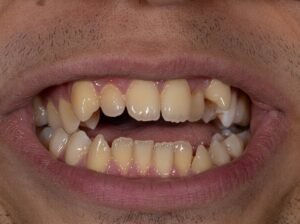
Hello! First of all, I want to tell you that if you've noticed that small gap between your teeth has come back, it’s not a serious issue, so there’s no need to overthink it. It’s much more common than you think and has a logical explanation based on how your body works. However, it is very important that we check it together soon, because you have to remember something fundamental: the mouth works as a whole, an integrated system where every part depends on the others. Any small change in one area, no matter how minor it seems, can affect the harmony, function, and stability of your entire smile in the long run.
Immediate Answer: Why does my "little gap" open and close?
What’s likely happening is a phenomenon called "opposing forces": your retainer pushes your teeth toward their ideal position at night, but your own bite, tongue, and soft tissues push them forward during the day. Think of it as a constant 24-hour battle. This is why it’s so common to wake up with your "little gap" perfectly closed and feel relieved, only to notice that as the hours go by—after talking, eating, and making facial expressions—the gap opens back up. This daily struggle isn't just frustrating; it wears down the stability of your tooth ligaments, making a professional adjustment necessary so your smile stays in place permanently without shifting back and forth.
Here is a short video where we explain in detail everything you need to know 👇.
The real reasons why your teeth "have memory"
To fix the problem at its root, we first need to understand the mechanics behind the movement. It’s not about a lack of care on your part; it’s simply the biology and physics of your mouth in action.
1. Retainers aren't forever and they lose their strength
Keep in mind that retainers, whether fixed or removable, are made of materials that—due to their elastic nature and constant use in a moist environment like the mouth—don't usually last more than one or two years. Over time, the plastic of an aligner micro-expands or the wire of a fixed retainer suffers from metal fatigue. Durability depends heavily on your habits; for example, if you grind your teeth due to stress (bruxism) or if your saliva chemistry
2. Occlusion conflict: The secret is in the bottom teeth
This is the part I love explaining to my patients most because it’s usually the "lightbulb moment": if your bottom teeth are hitting your top teeth incorrectly, they physically won't let me close that upper gap. Imagine you’re trying to close a front door, but there’s a doorstop on the floor blocking it just before it latches; no matter how hard you push the door (with retainers or braces), if you don't remove that doorstop, the door will never close. The same thing happens in your mouth. Often, the real and final solution isn't moving the top teeth, but aligning the bottom ones first and tucking them in slightly to take them out of occlusion (meaning, preventing them from acting as an obstacle for the front teeth). By creating that proper space in the lower arch, we automatically clear the path and gain the stability needed to permanently close the upper gap without anything pushing it back out.
3. The biology of your tissues and ligament "memory"
Your teeth are connected to the bone through tiny fibers called periodontal ligaments, which are extremely elastic. These fibers act like small rubber bands that were stretched during your original orthodontic treatment. If the retainer no longer fits with the same precision as day one, these fibers will try to retract, pulling the tooth back toward where it was before you wore braces. It is a natural biological process that only stops once the bite is perfectly balanced.
How are we going to get your smile back at AM Dental Studio?
At our clinic in Zapopan, our approach isn't just about "plugging" the gap temporarily. We want the result to be functional, long-lasting, and above all, something you love every time you see yourself in the mirror.
Invisible Orthodontics or Braces: You choose the speed and comfort
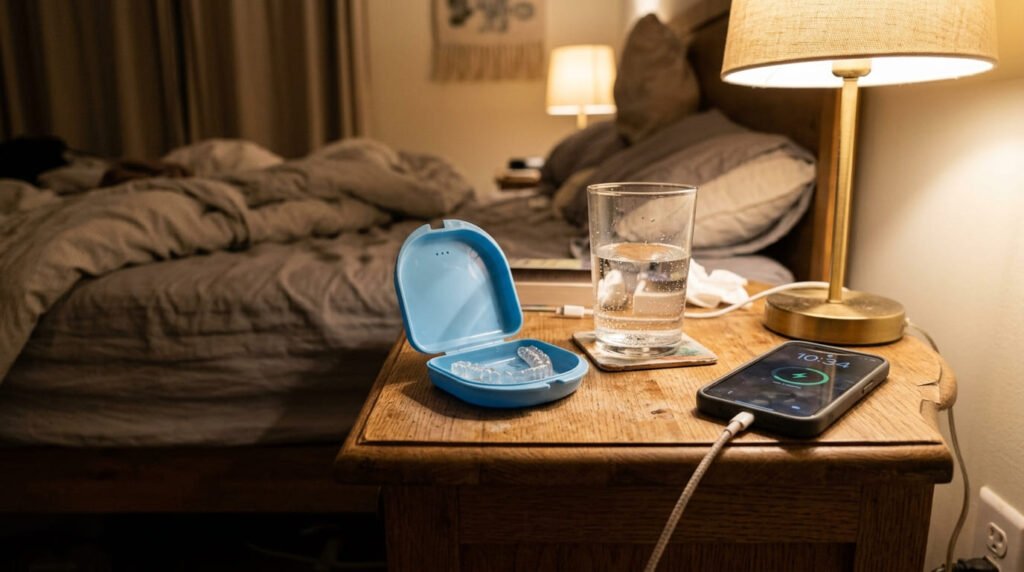
To correct this gap, the fastest and most effective option will always be braces, as they allow us absolute control over the tooth root. However, if you prefer something unnoticeable and your case is a simple relapse, we can achieve incredible results with clear aligners (such as Invisalign).
In these cases, to make everything fit perfectly, we sometimes perform a procedure called IPR, which is a tiny, millimeter-level trimming between the side teeth. It is as gentle as filing a fingernail, but it gives us the exact space needed for the front teeth to come together without bumping into their neighbors, achieving flawless alignment.
Reconstruction and Beautiful Anatomy: The final touch
Even if you notice that the shape of your teeth never fully convinced you or that they look worn down, we can take advantage of this adjustment to reconstruct them and give them a beautiful, youthful, and symmetrical anatomy. It’s not just about closing the gap; it’s about evaluating whether your teeth have the right size and texture for your face. By giving them a more aesthetic and balanced shape, we don’t just close the diastema—we reinforce the dental structure so the result is a harmonious smile that makes you feel proud in every photo.
Frequently Asked Questions with Dra. Alejandra Mora
1. Should I worry if the gap is almost unnoticeable? From an immediate health standpoint, it isn't an emergency. But from a clinical stability perspective, it is important. A small gap is like a crack in a wall: it’s a sign that there is incorrect pressure in your bite. It is much easier and more affordable to adjust it now than to wait until the shifting becomes more significant.
2. How long does it actually take to correct a gap that came back? It’s much faster than you think! Since it is a case of relapse (where the teeth have already moved before), the bone tends to respond more quickly. Depending on whether we use braces or aligners, it can take anywhere from a few weeks to just a few months.
3. What if my bottom teeth are straight but the gap at the top is still there? Sometimes the bottom teeth look "straight" to the naked eye, but their outward tilt is what's hitting the top teeth from behind. That’s why we perform a complete occlusion study during the first appointment to see what the untrained eye might miss.
Your smile is the most beautiful thing you have, show it off without fear!
You don't have to get used to smiling with your mouth closed or feel the need to hide your most authentic expression. At AM Dental Studio, we are here to listen to you, understand your fears, and find the technical solution that best fits your lifestyle and budget.
Always remember: your mouth is a living system that deserves to be in perfect balance to last a lifetime. Come visit us in Zapopan and let us make sure you can smile again with total freedom and confidence.